

What is Ritlecitinib powder used for?
In the field of autoimmune disease treatment, the iteration of JAK inhibitors is evolving from "broad-spectrum inhibition" to "precision targeting." Ritlecitinib Powder is a representative molecule of this trend. It is an orally administered, irreversible covalent small molecule inhibitor, chemically a dual-selective inhibitor of JAK3 kinase and the TEC kinase family. The ingenious aspect of its mechanism of action lies in the irreversible covalent bond formed between the acrylamide group in the molecule and a unique cysteine residue in the JAK3 kinase domain, thereby achieving long-term inhibition of the target.
🧬Stable molecular configuration of pyrrolopyrimidine-chiral piperidine
The chemical structure of Ritlecitinib Powder consists of three core units: a 7H-pyrrolo[2,3-d]pyrimidine pharmacological core, a (2S,5R)-chiral disubstituted piperidine ring, and a terminal acrylamide covalently bound fragment. The piperidine ring has two chiral centers; only the S-R configuration exhibits pharmacological activity, while the R-S isomer has almost no inhibitory activity. Asymmetric synthesis, chiral resolution, and anaerobic recrystallization were used to remove racemic mixtures, pyrimidine ring-opening impurities, and acrylamide hydrolysis products, preventing interference from impurities in kinase activity assays and hair follicle cell assays.
Removing the terminal acrylamide group allows the molecule to reversibly bind to the ATP pocket, quickly dissociating from the JAK3 kinase and significantly reducing its inhibitory effect. If the chiral configuration of the piperidine ring is reversed, the molecule cannot adhere to the hydrophobic cavity of JAK3, losing its targeting selectivity. The pyrrolopyrimidine ring occupies the ATP-binding pocket of the kinase, and the acrylamide fragment is the key component for covalent binding. The molecule is stable for 24 months under sealed, light-protected conditions at -20°C. Acrylamide is easily hydrolyzed in aqueous solutions at room temperature, but the purified solid powder does not undergo amide hydrolysis or pyrimidine ring opening. After passage culture in CD8⁺ T lymphocytes and incubation in mouse plasma, the molecule maintains its intact conformation and remains stable for a long period.
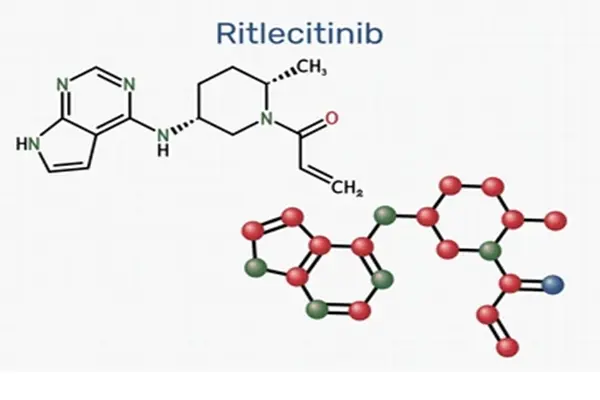
The α,β-unsaturated carbonyl group and the pyrrolopyrimidine ring of acrylamide are the core sites for its pharmacological activity. After entering immune cells, the pyrrolopyrimidine ring inserts into the ATP-binding pocket of JAK3, and the acrylamide double bond and the thiol group of Cys-909 undergo Michael addition, forming an irreversible covalent bond that permanently shuts down the JAK3 catalytic site. Other JAK isoforms (JAK1, JAK2, TYK2) have serine residues at the corresponding positions, lacking free thiol groups, and are almost unaffected by Ritlecitinib Powder, achieving ultra-high selectivity. Once acrylamide is hydrolyzed or the pyrimidine ring structure is destroyed, the covalent binding ability disappears, and the inhibitory activity against JAK3 is completely lost. The intact pyrrolopyrimidine-chiral piperidine-acrylamide skeleton is a necessary prerequisite for the Ritlecitinib Powder to function.
The hydrophobic alkyl group of the chiral piperidine ring and the polar pyrimidine ring work together to balance the lipid-water partition coefficient. The pyrrolopyrimidine ring carries a polar nitrogen atom, allowing for complete dissolution in cell culture media and acidic buffers. The methyl alkyl fragment of the piperidine ring provides moderate lipid solubility, helping the molecule cross the lymphocyte cell membrane and enter the cell. Highly polar derivatives have difficulty penetrating cell membranes, and molecules with excessive lipid solubility can accumulate in the liver and cause toxicity. Ritlecitinib powder balances cell membrane penetration efficiency with physiological solvent dispersibility, making it suitable for large-scale primary lymphocyte culture and high-throughput kinase subtype screening.
This molecule does not indiscriminately inhibit all types of kinases systemically, but only targets the JAK3 and TEC families; broad-spectrum JAK inhibitors also inhibit JAK1, interfering with the IL-6 signaling pathway and leading to thrombosis and infection risks; Ritlecitinib has an IC50 > 10000 nM of inhibitory activity against JAK1-JAK2-TYK2, exhibiting selectivity more than 300 times higher. If acrylamide is prematurely hydrolyzed, the probability of off-target effects increases, and the bias in in vitro cell assay data increases significantly.
⚙️Three molecular pathways regulate autoimmune responses
Under normal conditions, in a healthy body, JAK3 responds appropriately to γ-chain cytokine signals, STAT-5 phosphorylation levels remain within the baseline range, CD8⁺ T cells do not attack their own hair follicle cells, inflammatory factor secretion levels are reasonable, and there is no exogenous small molecule interference with immune cell signaling circulation.
However, in cases of alopecia areata or vitiligo, CD8⁺ cytotoxic T cells are abnormally activated, JAK3 is continuously activated, STAT-5 is heavily phosphorylated, and IL-2 and IL-15 are released in large quantities. Killer T cells infiltrate hair follicle tissue, destroying hair follicle stem cells and ultimately causing hair loss. Traditional JAK-1/3 dual inhibitors have a broad inhibitory range, interfering with normal immune homeostasis. Ritlecitinib powder with substandard purity contains acrylamide hydrolysis impurities, which non-specifically stimulate lymphocytes, distorting experimental results. Reversible JAK-3 inhibitors have short binding times, requiring high daily doses to be effective.
Ritlecitinib powder enters T lymphocytes through moderate lipid solubility and achieves a three-tiered regulatory effect through covalent binding. The first tier irreversibly inactivates JAK-3 kinase: pyrrolidine binds to the ATP pocket, and acrylamide and Cys-909 covalently bind, permanently shutting down JAK-3 catalytic activity, blocking IL-2, IL-7, and IL-15-mediated STAT-5 phosphorylation, and inhibiting excessive proliferation of Th1 and Th17 cells. The second tier inhibits TEC family kinases: inhibiting ITK and BTK activity, reducing B-cell activation and autoantibody production, and decreasing NK cell killing activity. The third tier improves the hair follicle microenvironment: reducing CD8⁺ T-cell infiltration into hair follicles, relieving immune cell damage to hair follicle stem cells, and promoting the re-entry of atrophied hair follicles into the growth phase. Ritlecitinib powder, because it does not act on JAK-1 and does not inhibit the IL-6 signaling pathway, exhibits significantly reduced side effects such as thrombosis, severe infection, and dyslipidemia compared to tofacitinib. It is suitable for the development of oral alopecia areata preparations, the investigation of kinase covalent binding mechanisms, the construction of 3D hair follicle organoid models, and the development of lead molecules for inflammatory bowel disease.
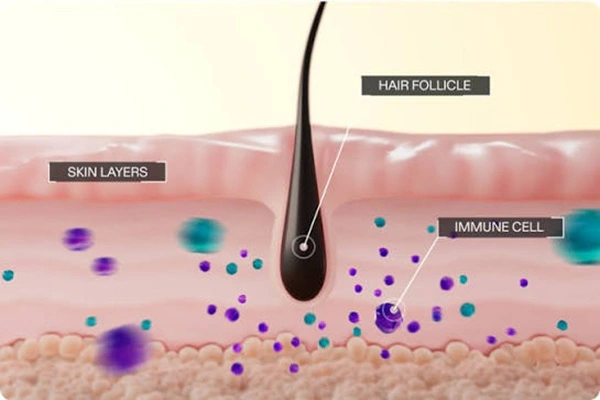
Ritecitinib powder only targets the overactivated JAK-3-TEC pathway, without disorderly interfering with the normal physiological processes mediated by JAK1-JAK2. Broad-spectrum JAK heterocyclic molecules generally inhibit multiple kinase pathways, interfering with normal immunity and causing distortions in cell assays. Ritlecitinib's target specificity allows the experimental system to focus solely on the core variable JAK-3-STAT-5, significantly improving the reliability of conclusions from pharmacological studies of autoimmune diseases.
🧫Multi-faceted applications in new drug development and biochemical research
Ritlecitinib powder is a standard reference material for studying the covalent inhibition mechanism of JAK-3, primarily used for constructing in vitro kinase-binding models of primary CD8⁺ T cells and three-dimensional hair follicle organoids. Gamma-chain cytokine-mediated immune activation is entirely dependent on JAK-3. Leveraging the covalent binding and high subtype selectivity of Ritlecitinib powder, a cell incubation system free from hydrolytic impurities can be formulated to perform kinase IC50 assays, STAT-5 phosphorylation quantification, and to establish a covalent JAK inhibitor screening platform, comparing the selectivity differences of various pyrimidine derivatives for JAK-3, JAK-1, and the TEC family.
Ritecitinib powder is widely used in pharmacological studies of severe alopecia areata and ulcerative colitis, and in constructing CD8⁺ T cell-mediated alopecia areata mouse models. Under pathological conditions, JAK-3 is continuously activated. Ritlecitinib powder provides long-term inhibition of kinase activity. This study observes the compensatory changes in immune cells and hair follicle tissue after long-term administration, screens for covalent kinase lead compounds with low systemic side effects, and improves the drug screening platform for autoimmune diseases.
It has irreplaceable value in the development of oral targeted drug intermediates for developing next-generation highly selective JAK-3 inhibitors. Existing drugs still suffer from folliculitis side effects due to a small amount of TEC kinase inhibition. Using Ritlecitinib as a starting building block, modifying it with acrylamide fragments or piperidine cycloalkyl groups further enhances JAK-3 specificity and reduces BTK-ITK inhibition, developing a once-daily oral active pharmaceutical ingredient with fewer side effects, and exploring its combination with topical anti-inflammatory agents.
In the development of novel covalent kinase lead molecules worldwide, Ritlecitinib powder is used as a pharmacodynamic control sample. Various pyrimidine ring-modified derivatives, lymphocyte-targeting prodrugs, and selective TEC-JAK-3 modulators are compared with Ritlecitinib powder in terms of covalent binding efficiency, kinase selectivity, and normal somatic cytotoxicity. Its stable biological activity and reproducible cell and animal experimental data make it a standard reference for high-throughput screening and structure-activity relationship analysis of pyrrolopyrimidine covalent inhibitors.
🔬Iterative optimization of molecular framework
Modification of the piperidine cycloalkyl side chain is a mainstream direction in the molecular engineering of Ritlecitinib. The original molecule is uniformly distributed throughout the body, with limited local enrichment in skin follicles. Modification of the methyl terminus of the piperidine ring, by attaching a cell-affinity fragment or skin-targeting group, results in greater enrichment of the derivative in the scalp follicles, allowing for lower dosage to suppress local immune responses, reduce drug exposure in the bloodstream, lower the risk of systemic immunosuppression, and develop safer oral formulations.
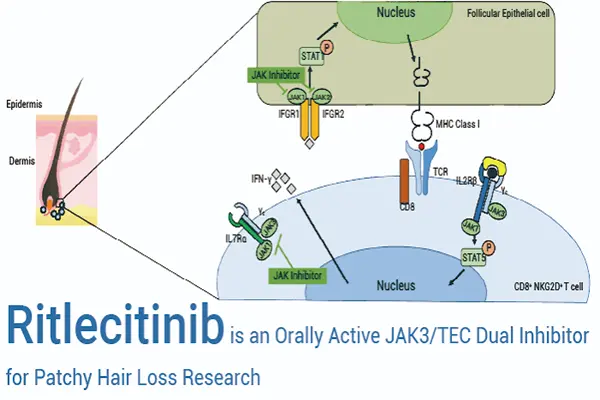
Tissue microenvironment responsive modification is a current hot research direction. Researchers attach a masking group that can be cleaved by specific esterases within inflammatory T-cells to the acrylamide site; the prodrug remains inert in normal blood and liver cells, without covalent binding; only when the masking group infiltrates activated CD8⁺ T-cells in the hair follicles hydrolyzes and detaches, releasing the active Ritlecitinib core, further improving lesion selectivity and reducing side effects such as folliculitis and herpes zoster.
Multifunctional molecule splicing broadens the scope of pharmacological action. Patients with alopecia areata often experience low-grade scalp inflammation. By covalently binding a pyrrolizidine core and an anti-inflammatory and antioxidant fragment, a new molecule was developed that inhibits JAK-3 kinase while simultaneously reducing local inflammatory infiltration in hair follicles, creating a composite lead molecule with both immunosuppression and scalp repair properties.
Substitution of the peripheral groups of the pyrrolizidine ring can alter the therapeutic bias. The original Ritlecitinib simultaneously inhibits JAK-3 and TEC family kinases; site-specific modification of the pyrimidine ring substituents can prepare highly selective derivatives that target only JAK-3 or derivatives that preferentially inhibit BTK-ITK. The highly JAK-3 selective version can be used for alopecia areata treatment, while the BTK-biased derivative can be used in rheumatoid arthritis research, achieving precise regulation of immune pathways based on subtype.
Conclusion
Ritlecitinib Powder is a small molecule drug that achieves irreversible selective inhibition of the JAK3/TEC kinase family via a covalently coupled acrylamide warhead. Its selectivity for JAK3, exceeding 10,000 times that of other JAK family members, is a molecular characteristic that distinguishes it from pan-JAK inhibitors. In the treatment of alopecia areata, the ALLEGRO trial demonstrated that it can induce hair regrowth with a SALT ≤ 20 in 23% of severe patients, covering adolescents aged 12 years and older. Continued exploration in indications such as ulcerative colitis, vitiligo, and Crohn's disease is expanding the application boundaries of this covalently coupled JAK3/TEC dual inhibitor from skin autoimmune diseases to a broader range of immune-mediated diseases.
Xi'an Faithful BioTech Co., Ltd. combines advanced manufacturing technology with a comprehensive quality assurance system to provide high-quality Ritlecitinib Powder that meets international pharmaceutical standards. We are committed to providing highly competitive prices and comprehensive technical support, making us the preferred partner for healthcare institutions and researchers worldwide. Please contact our technical team (allen@faithfulbio.com) to learn how our products can improve your formulations.
References
- Selleck Chemicals. (n.d.). PF-06651600 (Ritlecitinib).
- NCATS Inxight Drugs. (n.d.). RITLECITINIB. National Center for Advancing Translational Sciences.
- AbMole BioScience. (n.d.). Ritlecitinib Certificate of Analysis (M6308).
- Therapeutic Goods Administration. (2024). Litfulo (ritlecitinib) Australian Prescription Medicine Decision Summary.
- The Journal of Pharmacology and Experimental Therapeutics. (2025). Evaluation of JAK3 Biology in Autoimmune Disease Using a Highly Selective, Irreversible JAK3 Inhibitor.
- Bioss Antibodies. (n.d.). Ritlecitinib (bs-83769c).
- DailyMed. (2026). LITFULO (ritlecitinib) capsules, for oral use. U.S. National Library of Medicine.