

What is the drug Methotrexate used for?
Methotrexate powder is an orange-yellow to yellow crystalline powder, a classic folic acid antagonist pharmaceutical raw material with both antitumor and immunosuppressive activities. Its residual solvent, heavy metal, related substances, microorganisms, and endotoxin levels strictly comply with international pharmacopoeia standards such as USP and EP. This raw material has weak water solubility but is soluble in dilute alkaline solutions. It is chemically stable and, based on its core mechanism of antagonizing folic acid metabolism, blocks cellular nucleic acid synthesis. It can be used for chemotherapy of malignant tumors and can also intervene in the progression of autoimmune diseases.
🧪 Molecular Physicochemical Analysis of Heterocyclic Conjugated Framework Construction
The molecule of Methotrexate Powder consists of a fused heterocyclic core formed by a pteridine ring linked to a para-aminobenzoic acid structure, with glutamic acid segments as side chains, creating a rigid molecular system highly similar to natural folic acid. The tightly bound conjugated chemical bonds within the fused heterocyclic ring result in a stable atomic arrangement. Under normal conditions of storage at room temperature, away from light, and in a sealed container, the ring will not undergo structural changes such as breakage, molecular rearrangement, or group loss, ensuring the long-term quality stability of the powder from the molecular level. The nitrogen and oxygen atoms distributed on the heterocyclic ring, as well as the amino and carboxyl groups on the side chains, form abundant hydrogen bonds and ion binding sites, enabling precise binding to the active region of dihydrofolate reductase. This is the structural basis for the molecule's ability to mimic folic acid and occupy enzyme binding sites.
This raw material exhibits significant selectivity in its solubility. Methotrexate Powder has low solubility in common solvents but dissolves readily in acidic and alkaline aqueous solutions, forming a stable system after dissolution. The pH of the raw material solution changes with the solvent system, and trace amounts are prone to precipitation in a neutral aqueous environment. Therefore, formulation production involves the targeted selection of appropriate excipients and solvent systems. While the overall molecule tolerates normal room temperature, prolonged exposure to strong direct light or temperatures exceeding 90°C can cause oxidative decomposition of the phenobarbital heterocycle, resulting in the loss of active ingredients. Therefore, strict light protection and temperature control are essential during raw material storage, formulation production, and finished product storage to prevent quality degradation caused by environmental factors.
From a powder processing perspective, industrially mass-produced Methotrexate Powder crystals exhibit uniform particle size, a concentrated particle size distribution, regular particle morphology, a moderate angle of repose, and excellent overall flowability. In continuous processes such as mixing, granulation, tableting, capsule filling, and freeze-drying in automated pharmaceutical production lines, material transport is smooth, preventing bridging, sticking, and localized agglomeration. It is fully compatible with the high-speed production standards of oral and aseptic injectable formulations. The raw material has low hygroscopicity. Under normal storage conditions (70% relative humidity), sealed storage for 36 months shows no significant changes in powder color or bulk density. Irreversible degradation only occurs under extreme conditions of high humidity and strong oxidants. Routine storage management is simple and easy to control.
The selectivity and safety characteristics of the molecule are determined by its structure. Methotrexate Powder, by mimicking the structure of folic acid, preferentially acts on rapidly dividing and proliferating cells, with limited impact on normally metabolizing, slowly functioning cells. Adverse reactions are within a controllable range at conventional clinical doses. After entering the human body, the drug is primarily metabolized in the liver, breaking down into pharmacologically inactive metabolites. The vast majority of the components are excreted through the kidneys in urine, with a small amount excreted through the bile duct. The risk of accumulation in individuals with normal liver and kidney function is extremely low. Combined with a stable heterocyclic skeleton, unique solubility properties, excellent powder processing performance, and controllable metabolic characteristics, this active pharmaceutical ingredient is a high-quality core material for the development of chemotherapy drugs for tumors and treatments for autoimmune diseases.
⚙️ Antagonizes folic acid metabolism and blocks cell division and proliferation pathways
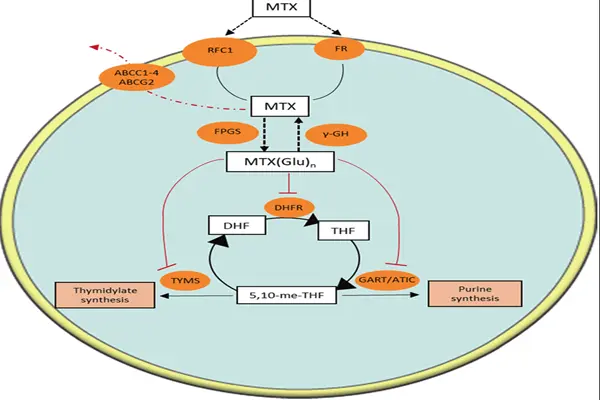
After Methotrexate Powder is administered orally, intravenously, or topically, it enters the body through a process highly similar to natural folic acid. This allows it to be actively taken up by the body's cells and exert its effects. Folic acid is essential for the synthesis of DNA and RNA in human cells. The entire process of cell division, proliferation, and growth relies on the metabolic cycle involving folic acid. Tumor cells and abnormally activated immune cells divide at a much faster rate than normal cells, significantly increasing their demand for folic acid. This is the core entry point for Methotrexate Powder to exert its effects.
Once inside the cell, Methotrexate Powder competitively binds to dihydrofolate reductase, a key catalytic enzyme in the folic acid metabolic chain. The affinity between the molecule and the enzyme is much higher than that of natural folic acid, allowing it to occupy the enzyme's active site for a long time, preventing the reductive conversion of normal folic acid. The folic acid metabolic pathway is thus forcibly interrupted, preventing the cell from producing biologically active tetrahydrofolate. Consequently, the raw materials needed for nucleic acid synthesis become scarce, and the synthesis of DNA and RNA is forced to halt.
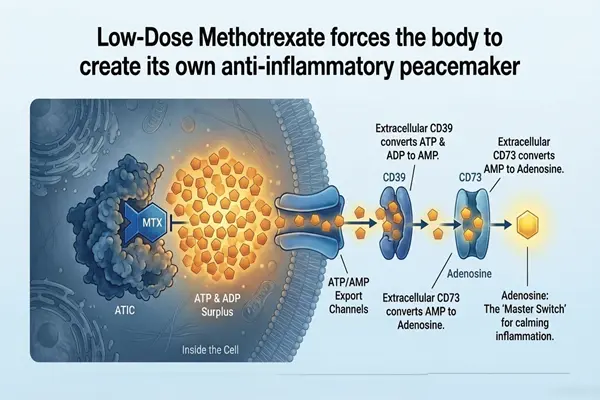
When nucleic acid synthesis is inhibited, rapidly dividing cells cannot complete the replication of genetic material, and the cell division cycle directly arrests in prophase, completely halting the unlimited proliferation of abnormal cells. For tumor lesions, continuous medication can gradually inhibit tumor cell growth, induce apoptosis in abnormal cells, reduce tumor size, and prevent cancer cell invasion and metastasis. For autoimmune diseases such as rheumatoid arthritis and psoriasis, the drug can inhibit the proliferation of overactivated lymphocytes and inflammatory cells, reduce the release of inflammatory factors, and alleviate typical symptoms such as joint swelling and pain, and skin lesions.
The effects exhibit a clear dose- and concentration-dependent pattern. At low doses, it primarily exerts an immunosuppressive effect, gently regulating the immune system and suitable for long-term maintenance therapy of chronic autoimmune diseases. At therapeutic doses, the cytotoxic effect is significantly enhanced, powerfully killing rapidly dividing tumor cells, and is used for systemic chemotherapy of malignant tumors. The drug's action follows a cell cycle-specific mechanism, primarily acting on the S phase of cell division, with the most prominent inhibitory effect on cells in the nucleic acid synthesis stage. Clinically, the dosage and frequency of administration can be precisely adjusted based on the type of disease.
💊 Multi-dosage formulations cover the entire spectrum of oncology and immune diseases
- Oral tablets and hard capsules are the most widely used oral dosage forms of Methotrexate Powder and are the mainstream choice for long-term treatment of chronic diseases. During production, the raw materials are mixed with pharmaceutical excipients such as lactose, microcrystalline cellulose, disintegrants, and lubricants, granulated, and then compressed into tablets or capsules. This dosage form is convenient to take and offers precise dosage division. It is mainly used for the long-term control of rheumatoid arthritis and psoriasis vulgaris, and can also be used as an oral administration regimen for combination chemotherapy in malignant tumors. It has a large circulation in hospitals at all levels, community health institutions, and retail pharmacies, meeting the needs of long-term home medication.
- Lyophilized powder for injection is a core dosage form for cancer chemotherapy and the treatment of severe immune diseases, targeting malignant solid tumors, hematological malignancies, severe rheumatoid arthritis, and other severe conditions. During production, high-purity raw materials are dissolved in a special solvent, sterilely filtered, filled, and lyophilized to produce the finished product, significantly improving the storage stability of the formulation. In clinical use, after reconstitution, the drug is administered via intravenous drip or intramuscular injection. It enters the bloodstream rapidly, achieves high blood concentrations, and exhibits strong anti-tumor and immunosuppressive effects. Primarily used in inpatient wards, oncology departments, and rheumatology departments, it is a key preparation for intensive treatment of critically ill patients.
- Oral suspensions are a specialized dosage form specifically designed for pediatric patients, elderly individuals with swallowing difficulties, and those who are frail. Methotrexate powder is combined with suspending agents, flavoring agents, and buffering excipients to form a dry suspension. Before use, it is shaken with warm water to form a homogeneous suspension. The dosage can be flexibly adjusted according to age and weight, and the taste has been optimized to effectively improve medication adherence in special populations. It is widely used in pediatric outpatient clinics and rehabilitation departments, refining dosing regimens for different populations.
- Topical preparations are specific dosage forms for localized symptoms. The raw materials are dispersed in a cream or gel matrix to form a topical ointment, which is applied directly to the affected area of the skin. The drug achieves an effective local concentration, directly targeting the abnormally proliferating skin cells and inflammatory cells at the lesion site. It has a rapid local onset of action and minimal systemic absorption, significantly reducing systemic adverse reactions. It works only on the surface of the skin, making it a commonly used topical treatment for mild to moderate psoriasis.
High-purity raw materials are primarily used in quality testing and research. Methotrexate powder with a purity ≥99.5% is used as a legal chemical reference by pharmaceutical testing institutions and quality control laboratories worldwide for content determination, related substance testing, and potency evaluation in various formulations. In pharmacology laboratories and new drug development platforms, this raw material serves as a positive control tool for folic acid metabolism pathway research, screening of antitumor and immunomodulatory compounds, and comparative pharmacodynamic analysis, making it an indispensable reference material in the relevant drug development chain.
🔬 Technological iteration and new application systems
Upgrading green synthesis and purification processes is a primary optimization direction for the industry. Traditional synthesis routes are complex, requiring large amounts of polar organic solvents, resulting in high energy consumption and significant costs and environmental pressures related to waste treatment. Currently, the industry is promoting biocatalysis technology and continuous flow synthesis processes, replacing traditional reagents with low-toxicity, recyclable solvents and simplifying the reaction process. The new process, while maintaining stable product purity and crystal form, increases overall production yield by 7 percentage points, reduces organic solvent consumption by 53%, and controls related substance content in the finished product to below 0.10%, fully complying with international GMP and green pharmaceutical standards, thus helping domestically produced raw materials enter the global high-end pharmaceutical market.
Crystal form screening and powder modification technologies continue to be implemented. Primary crystal forms exhibit uneven dispersion and trace precipitation issues in neutral aqueous solutions and some paste matrices. Technicians are using methods such as low-temperature controlled crystallization and solvent gradient crystallization to screen for novel pharmaceutical crystal forms with superior solubility and dispersibility. Simultaneously, airflow micronization technology is employed to precisely control powder particle size. The refined powder exhibits more uniform distribution in suspensions, topical gels, and lyophilized formulations, preventing issues such as stratification, precipitation, and crystallization during long-term storage, effectively improving the overall quality and shelf life of downstream formulations.

Targeted delivery formulations have become a cutting-edge research hotspot. Traditional drug delivery methods distribute drugs systemically, which can negatively impact the body's normally rapidly dividing cells. The research team has developed targeted systems such as liposomes, polymer nanoparticles, and antibody-drug conjugates, encapsulating Methotrexate Powder to achieve targeted enrichment at lesions. Targeted carriers can guide drugs to concentrate on tumor tissue, diseased joints, and skin lesions, increasing local drug concentration and reducing drug exposure in normal tissues. This significantly reduces toxic side effects while ensuring efficacy. Several targeted formulations are currently in the preclinical validation stage.
The development of long-acting sustained-release formulations is progressing steadily. For patients with rheumatoid arthritis and recurrent psoriasis requiring long-term, regular medication, sustained-release tablets and sustained-release microspheres are being developed. By utilizing polymeric sustained-release frameworks or biodegradable carriers, the release and absorption rates of drugs are slowed down, stabilizing blood drug concentrations throughout the day, reducing the frequency of daily dosing, and improving patient adherence to long-term medication. Sustained-release formulations also avoid discomfort caused by drastic fluctuations in blood drug concentrations, making long-term treatment more gentle and possessing broad market application prospects.
Conclusion
Methotrexate Powder, with its pteridine-glutamate complex heterocyclic molecular structure, precisely antagonizes dihydrofolate reductase by mimicking the natural form of folic acid, blocking cellular folic acid metabolism and nucleic acid synthesis. It possesses both potent anti-tumor and immunosuppressive effects. Leveraging its physicochemical properties suitable for multiple dosage forms, various formulations, including oral, injectable, and topical, comprehensively cover the treatment scenarios of major diseases such as malignant tumors, rheumatoid arthritis, and psoriasis. Decades of clinical application have proven its efficacy and mature usage system. Its perfected synthesis and purification processes and stringent end-to-end quality control have established it as a benchmark in the field of folic acid antagonist APIs.
Xi'an Faithful BioTech Co., Ltd. combines advanced production technology with a comprehensive quality assurance system to provide high-quality Methotrexate Powder that meets international pharmaceutical standards. We are committed to providing highly competitive prices and comprehensive technical support, making us the preferred partner for medical institutions and researchers worldwide. Please contact our technical team (allen@faithfulbio.com) to learn how our products can improve your formulations.
References
- PubChem. (n.d.). Methotrexate (CID 126941). Retrieved June 15, 2026.
- AbMole BioScience. (n.d.). Methotrexate (Catalog No. M2351). Retrieved June 15, 2026.
- MedChemExpress. (n.d.). Methotrexate (HY-14519). Retrieved June 15, 2026.
- Sigma-Aldrich. (n.d.). Methotrexate (Product No. M9929). Retrieved June 15, 2026.
- TargetMol. (n.d.). Methotrexate (T0055). Retrieved June 15, 2026.