

The continued melting of giant icebergs has raised concerns about sea levels.
In recent years, the breaking and continuous melting of giant icebergs in the Arctic and Antarctic waters has become increasingly frequent, continuously raising concerns among the global climate science community and coastal nations. Data from multinational polar research satellites in 2026 showed that large icebergs broke off from ice shelves in the Antarctic Peninsula, the Weddell Sea, and the Amundsen Sea, with floating icebergs continuously breaking and melting under the influence of warming seawater. Many people hold the misconception that melting floating icebergs directly raise sea levels. However, global glaciologists have repeatedly warned that the deeper risk of iceberg melting lies not in the floating ice itself, but in the unstable polar ice shelf system behind the icebergs. Ice shelves act as a "natural barrier" preventing land-based glaciers from entering the sea. Once large-scale ice shelf breakup forms icebergs and melts, the barrier effect weakens, and massive amounts of glaciers attached to the land will accelerate their slide into the ocean, continuously replenishing the ocean with freshwater and driving a continuous rise in global sea levels.
Accelerated Iceberg Breakup: A Direct Climate Signal of Polar Warming
For nearly three decades, global polar observation networks have continuously recorded dramatic changes in iceberg activity. In the 1990s, large ice shelf breakup events in Antarctica occurred on average only once every few years; since the beginning of the 21st century, giant icebergs breaking off from ice shelves have become a common phenomenon. The previously world-renowned A23a iceberg, with an area reaching 4,170 square kilometers and a thickness of nearly 400 meters, completely disintegrated and melted in 2026 after drifting at sea for 34 years, becoming the most typical observational example of iceberg evolution in recent years. Polar satellites from various countries have continuously tracked the movement of thousands of large and medium-sized icebergs, discovering a significant increase in the rate of iceberg melting. The time required for icebergs of the same size to completely melt has shortened by nearly 40% compared to 20 years ago. Rising temperatures, changes in ocean circulation, and the intrusion of deep warm water into the bottom of ice shelves are multiple factors that have combined to create the current situation of concentrated iceberg breakup and melting.
Atmospheric warming, leading to surface melting, is the most superficial driving factor for iceberg melting. The polar amplification effect has caused the Arctic and Antarctic to warm at rates far exceeding the global average, with some areas of the Antarctic Peninsula experiencing temperature increases three times the global average. Summer warming leads to large amounts of meltwater accumulating on the ice surface and seeping into cracks. This meltwater continuously widens the cracks, breaking up intact ice shelves into multiple independent icebergs. Once these icebergs detach from their parent bodies and enter the ocean, surface melting continues to consume the ice. Long-term scientific observations have revealed that the distribution of meltwater pools on the ice surface is expanding southward year by year. Areas along the Antarctic coast that were previously covered by ice and snow are seeing a continuous increase in the area of exposed ice in summer, creating favorable conditions for iceberg calving. Simply relying on atmospheric warming to explain iceberg melting is incomplete; changes in ocean thermal activity are the more crucial driving force.
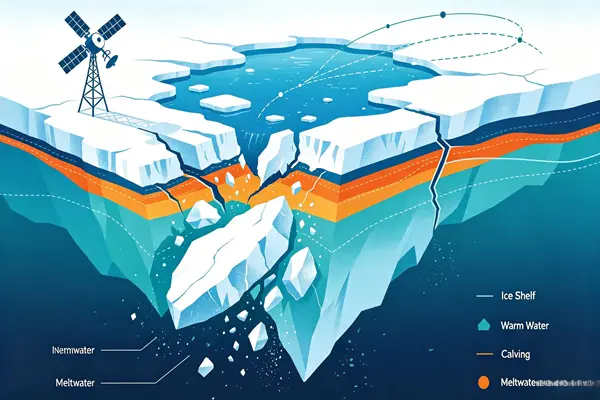
Deep-level warm water erosion of the ice shelf base is a key factor in the continued formation of giant icebergs. Over 90% of global greenhouse heat is ultimately absorbed by the ocean. Warming seawater flows along trenches into the cavities beneath ice shelves, continuously eroding the ice from the bottom. Compared to slow surface melting, bottom melting is more insidious and destructive. As ice shelves thin and lose support, large chunks of ice break off and flow into the sea, forming icebergs. A German polar research institution uses a vivid analogy: ice shelves are like "corks" plugging land glaciers; warm water continuously erodes the corks, causing them to break apart and form icebergs. Once the "corks" disappear, inland glaciers will flow unimpeded into the ocean. This is the fundamental reason why the scientific community continues to worry about the chain reaction of iceberg melting.
Local environmental factors such as ocean currents and wind further accelerate the iceberg breakup process. After breaking free from the ice shelf, icebergs drift slowly northward with ocean currents, gradually entering warmer waters. The continuous impact of warm and cold water on the iceberg's edges and the constant pounding of waves cause an imbalance of internal stress, gradually breaking into numerous small and medium-sized icebergs. Some large icebergs drift to shallower areas such as South Georgia Island, temporarily slowing the melting process, but as sea temperatures rise year by year, these grounded icebergs will eventually melt rapidly. Global ocean observation data shows that surface water temperatures in the Southern Ocean have been rising steadily over the past decade, and the cold water areas suitable for giant icebergs to float stably for a long time are shrinking.
Rising sea levels are triggering a global chain of ecological and social crises.
Continuous observations confirm that global sea levels are rising at an accelerating rate. From 1901 to 2018, global sea levels rose by approximately 20 centimeters. Based on current ice melt rates, under a high-emission scenario, global sea levels could rise by as much as 1.02 meters by 2100. Even small sea-level rises have a magnified impact. Slow coastline retreat, seawater intrusion into aquifers, and increased storm surge destructive power create multiple overlapping hazards, placing sustained pressure on coastal ecosystems and residents' lives and livelihoods. Currently, over 680 million people live in low-lying coastal areas globally, and the population in high-risk coastal areas is projected to exceed one billion by 2050, leading to a continuous expansion of climate risk coverage.
Coastal natural ecosystems are the first to bear the brunt of rising sea levels. Mangroves, salt marshes, and coral reefs form natural coastal protection zones and are habitats for numerous marine organisms. If the rate of sediment deposition cannot keep pace with the rising sea levels, mangroves will struggle to migrate inland, leading to the gradual disappearance of large areas of coastal wetlands. Coral reefs also face a dual threat: rising sea temperatures cause coral bleaching and death, while sea-level changes alter sunlight conditions, further shrinking coral habitats. The disappearance of coastal wetlands not only results in the loss of habitats for numerous species but also weakens the natural buffering capacity of coastlines. Healthy mangroves can mitigate wave energy; however, with large-scale wetland degradation, storm surges and waves significantly increase their erosive power on coastlines.
Seawater intrusion into groundwater aquifers threatens drinking water security and food production in coastal areas worldwide. Islands and coastal plains are highly dependent on groundwater resources; rising sea levels push saltwater intrusion into inland aquifers along geological fissures. Pacific island nations like the Maldives and Tuvalu have already experienced excessive groundwater salinity, leading to a continuous depletion of local freshwater resources, forcing them to rely on desalination and imported water for supply. In the Asian Delta agricultural region, saltwater intrusion along river channels causes soil salinization, resulting in a continuous decline in crop yields. Increased soil salinity makes it difficult for traditional rice and vegetable crops to grow normally, forcing coastal agricultural areas to adjust their planting structures and challenging the stability of food supply. The survival crisis for low-lying island nations is becoming increasingly severe. Some islands have a maximum elevation of less than two meters, and continuous tidal inundation is causing their land area to shrink year by year, giving rise to the problem of "climate migration."
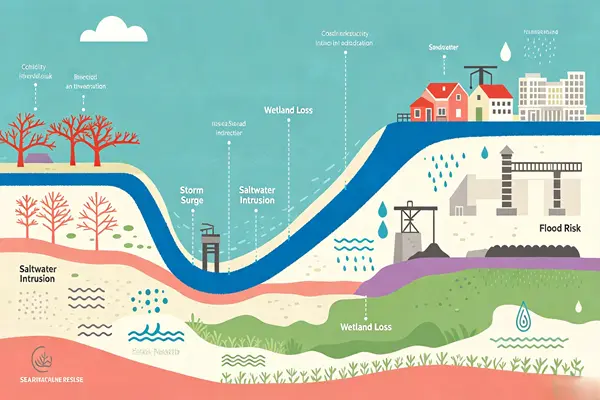
The destructive power of extreme marine disasters is being amplified simultaneously, with a significant increase in the frequency of floods. Sea level is the baseline for all marine disasters; for every tens of centimeters rise in the baseline sea level, storm surges of equal intensity can reach further inland areas. What was once a once-in-a-century catastrophic flood will become a once-in-decades event or even an annual occurrence. Many coastal cities rely on seawalls and tide gates to protect against seawater intrusion, but existing flood control engineering standards are mostly designed based on sea-level data from the last century, making them ill-suited to the continuously rising sea levels. Upgrading and raising coastal protection projects requires enormous funds, placing a huge financial burden on developing countries and small island nations. Some economically weak regions are unable to undertake large-scale coastal protection construction and can only passively endure the damage to houses and infrastructure caused by seawater intrusion.
The global economic supply chain faces continuous disruption. Many port cities, shipping hubs, and coastal industrial parks are located in low-lying coastal zones. Rising sea levels, coupled with extreme storms, will continue to threaten the safety of critical infrastructure such as ports, highways, power plants, and sewage treatment plants. Frequent seawater intrusion will corrode industrial equipment, damage urban drainage systems, and drive up daily urban maintenance costs. The coastal tourism industry will also be impacted, with continuous beach erosion and coastal landscape degradation, posing a risk of losing tourists to many coastal destinations. In the long run, the ongoing changes in coastlines will force some coastal industries to relocate, leading to a series of socio-economic problems such as industrial restructuring and changes in employment.
Slowing down cryosphere degradation and enhancing coastal adaptability
The continued melting of giant icebergs and the accelerating rise in sea levels are long-standing problems resulting from decades of continuous greenhouse gas emissions. Climate science consensus clearly states that even if global carbon emissions were drastically reduced immediately, greenhouse gases already released into the atmosphere would continue to drive sea levels up for centuries. Proactive responses can be divided into two main directions: continuously advancing global emissions reductions to slow the rate of polar ice cap melting as much as possible; and simultaneously improving climate adaptation programs to help high-risk regions withstand various disasters caused by sea-level rise. Both are indispensable; short-term adaptation measures buy time for long-term transformation, while deep emissions reductions lower the upper limit of future climate risks at their source.
Accelerating the implementation of emissions reduction targets and mitigating the trend of polar cryosphere degradation is the fundamental path. The Paris Agreement proposes limiting global warming to well below 2°C above pre-industrial levels, with efforts to limit warming to 1.5°C. Multiple ice sheet simulations show a significant difference in the scale of ice sheet loss in Antarctica and Greenland under scenarios of 1.5°C and 2°C. The lower the rate of warming, the lower the probability of large-scale instability and collapse of the West Antarctic ice sheet. Globally, countries need to accelerate energy structure transformation, reduce dependence on fossil fuels, promote renewable energy, and control greenhouse gas emissions from industry and transportation. Countries should fulfill their Nationally Determined Contributions (NDCs), promote transnational climate cooperation, and reduce cross-border carbon emission transfer. Only by curbing the continued global warming trend can we reduce the possibility of large-scale concentrated disintegration of giant icebergs and continuous damage to ice shelves.
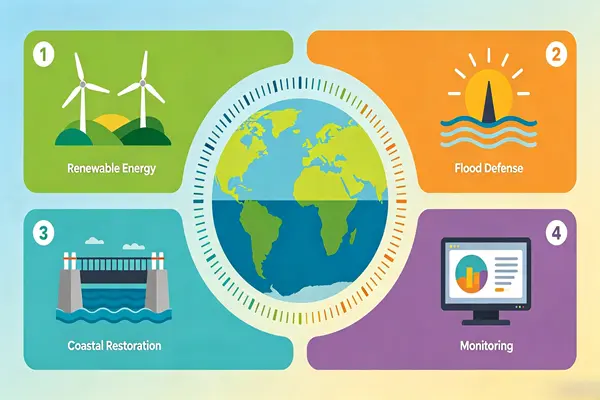
Improving polar observation and scientific research cooperation is crucial to enhancing climate risk prediction capabilities. The polar cryosphere spans multiple oceans, and no single country can independently conduct comprehensive monitoring. Countries should promote the open sharing of polar observation data and jointly build cross-regional iceberg tracking and ice shelf monitoring networks. Continued investment in underwater exploration, satellite remote sensing, and polar field research projects is essential to clarify the complete mechanisms of ice shelf melting and iceberg evolution, and optimize sea-level rise prediction models. Accurate climate prediction can help coastal cities reserve risk buffer space in long-term land use planning and infrastructure construction. Research results should be transformed into popular science and policy references for the public and local governments, dispelling public misconceptions about iceberg melting and sea-level changes.
A tiered approach to coastal climate adaptation programs is needed to mitigate sea-level threats based on local conditions. The global coastal regions exhibit vastly different economic levels and geographical conditions, making a uniform solution impossible. Large, densely populated coastal cities can systematically upgrade hard protective infrastructure such as seawalls and storm surge barriers, while simultaneously renovating urban drainage systems to enhance their ability to withstand storm surges. Areas with extensive coastal wetlands should prioritize ecological protection solutions, restoring mangroves and seagrass beds to leverage natural ecosystems to mitigate wave erosion. For small islands and coastal villages with extremely low elevations and prohibitively high protection costs, planned relocation strategies must be developed in advance. All countries should incorporate sea-level rise into their national spatial planning, strictly limiting the construction of large-scale projects along high-risk coastlines to prevent a continued increase in the population and assets exposed to climate risks.
Conclusion
There are no bystanders in the climate crisis. Developed countries, developing countries, and low-lying island nations bear different historical responsibilities and current risks. Only by upholding multilateral cooperation, balancing development demands with climate protection goals, and taking into account both fairness and efficiency, can we steadily enhance global climate resilience. By continuously tracking signals from melting icebergs and changes in ice shelves, respecting the climate warnings conveyed by the cryosphere, and taking proactive and early action, humanity has a chance to mitigate the catastrophic impact of rising sea levels and protect the homes on which hundreds of millions of people along the world's coasts depend for survival.
Disclaimer: The information published on this website is sourced from the internet and does not represent the views of this website, nor does it guarantee the accuracy of its content. Please be aware of the distinction. Furthermore, the products provided by our company are for scientific research purposes only. We are not responsible for any consequences arising from improper use. If you are interested in our products, have any criticisms or suggestions regarding our articles, or are not completely satisfied with the products you received, please contact us by email: allen@faithfulbio.com Or WhatsApp: +86 13137770562; our team is dedicated to ensuring complete customer satisfaction.