

The global construction industry accounts for 37% of total carbon emissions; the United Nations calls for accelerated decarbonization.
In May 2026, the United Nations Environment Programme, in conjunction with the Global Alliance for Building and Construction, released the "2025-2026 Global Building and Construction Industry Status Report." The report's core data clearly shows that the entire building and construction industry chain accounts for 37% of global energy-related carbon emissions, and the industry's annual energy consumption reaches 28% of global total energy consumption. Furthermore, nearly half of global mineral resource extraction activities serve building material production, making it the world's largest and slowest-moving high-emission industry in terms of emissions reduction. The report points out that with the continued acceleration of global urbanization, the average new building area added globally every five days is equivalent to the entire city of Paris. Many new buildings still use high-carbon building materials and inefficient energy-consuming designs, and the energy efficiency renovation of existing buildings is progressing slowly. The industry's overall decarbonization pace is far from matching the Paris Agreement's target of limiting global warming to 1.5 degrees Celsius.
The core causes of high carbon emissions in the construction industry
The construction industry accounts for nearly 40% of global carbon emissions. This is not due to pollution from a single stage, but rather the result of continuous greenhouse gas releases from dozens of sub-stages throughout the entire lifecycle of a building, from mining and building material processing to construction, long-term operation, and demolition and recycling. This, coupled with the increased construction volume brought about by rapid global urbanization, has driven up the industry's overall carbon emissions, which is the core reason why the United Nations is urgently calling for accelerated decarbonization. From a carbon emission structure perspective, the industry's carbon emissions are clearly divided into two major segments: embodied carbon and operational carbon. These two types of carbon emissions contribute roughly 50/50, with no single decisive source of emissions. This means that emission reduction in the construction industry cannot focus solely on the building's usage phase; it must simultaneously control the upstream building material manufacturing process. A lack of control at any end will significantly weaken the overall emission reduction effectiveness.
Embedded carbon refers to the accumulated carbon emissions from all stages before the building's completion, accounting for approximately 17% of the industry's total emissions. The core sources are concentrated in the production processes of three essential building materials: cement, steel, and flat glass. Cement production is the largest contributor to occult carbon emissions. The traditional silicate cement firing process not only consumes large amounts of coal to provide high temperatures, but the high-temperature decomposition of calcium carbonate also actively releases carbon dioxide. Each ton of ordinary cement can emit up to 550 kg of CO2 equivalent. With global annual cement production exceeding 4 billion tons, cement alone releases billions of tons of greenhouse gases annually. Steel follows closely behind. Steel smelting relies on coke, and the iron ore reduction process has extremely high carbon emission intensity; one ton of ordinary construction steel emits over 1200 kg of carbon. High-rise residential buildings, large public buildings, and bridge infrastructure all require massive amounts of steel. Flat glass and ceramic tiles also require continuous heating in high-temperature kilns, with coal and natural gas as the main heat sources continuously generating carbon emissions. In addition, upstream mining, sand and gravel extraction, long-distance transportation of raw materials, the operation of large diesel construction machinery during construction, and the storage and transfer of building materials all continuously generate greenhouse gases, all of which are included in the category of occult carbon emissions from buildings. The current surge in urbanization in emerging economies worldwide, with numerous residential buildings, industrial parks, and road infrastructure projects commencing simultaneously, has led to a continuous increase in demand for cement and steel. This has resulted in a steady annual rise in implicit carbon emissions, making it the most challenging upstream hurdle for emissions reduction in the industry.
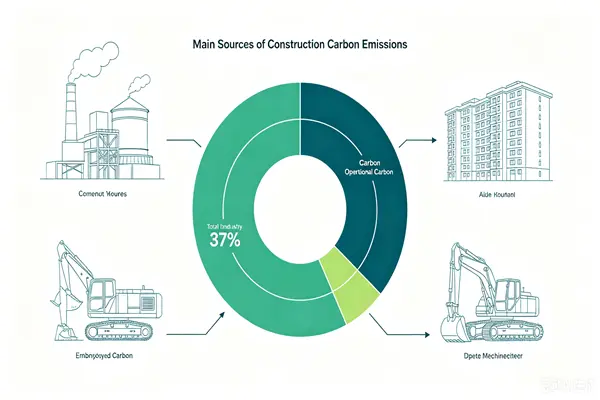
Operational carbon refers to the carbon emissions generated continuously over a decades-long lifespan after a building is completed and put into use, accounting for approximately 20% of the industry's total emissions. Heating and cooling are the core sources of operational carbon. Buildings in different climate zones worldwide have temperature control needs. Temperate and frigid cities in the Northern Hemisphere rely on coal-fired boilers and gas-fired wall-mounted boilers for heating in winter, while tropical and subtropical cities run air conditioning 24/7 in summer. Traditional air conditioning equipment relies on coal-fired power plants for electricity, and the power generation process releases large amounts of carbon dioxide, creating a chain reaction of "electricity consumption – carbon emissions from power generation." Ordinary residential buildings, shopping malls, office buildings, hospitals, schools, and other public buildings generally suffer from poor thermal insulation performance in their building envelopes. Older buildings often lack insulation layers in their walls and use single-pane windows, leading to rapid heat loss from indoors and continuous infiltration of outdoor heat. Residents are forced to rely on prolonged use of air conditioning and heating to maintain comfortable temperatures, further amplifying electricity and fossil fuel consumption. Besides temperature control, daily lighting, elevator operation, commercial equipment operation, and water supply and drainage system pressurization all require continuous electricity consumption. Public buildings, due to high foot traffic and 24/7 equipment operation, have significantly higher carbon emissions per unit area than residential buildings. Currently, over 70% of the world's existing buildings were constructed more than 20 years ago, with low energy efficiency standards and a lack of supporting clean energy equipment such as photovoltaics and ground source heat pumps. These existing buildings create a huge operational carbon stock that is difficult to quickly achieve through energy efficiency upgrades in the short term.
The rapid urbanization worldwide has led to an expansion in building scale, continuously widening the overall gap in both types of carbon emissions and further exacerbating the pressure on industries to decarbonize. UN statistics show that by 2050, more than half of the world's existing buildings will not have started construction. In the next two decades, a massive number of new residential and public buildings will be added globally, and the design standards for these new buildings will directly determine the industry's carbon emission ceiling for the next few decades. If countries continue to use outdated designs with traditional high-carbon building materials, inefficient building envelopes, and no clean energy support, these new buildings will create a high-carbon lock-in effect that will last for decades. Even with stringent emission reduction policies in the future, it will be difficult to quickly reduce existing emissions. Developing countries are experiencing faster urbanization, and many small and medium-sized cities have not yet enacted mandatory green building regulations. New residential buildings and self-built houses in rural areas generally do not adhere to energy-saving standards, and the procurement of building materials prioritizes low-priced, high-carbon cement and steel, directly driving up global carbon emissions from new buildings. In contrast, in developed countries, urban construction has reached saturation, and the scale of new construction is limited. However, the stock of old buildings in the country is huge. Many residential and office buildings built in the last century have aging insulation, cooling and heating systems, resulting in high carbon emission intensity. Countries at different stages of development face two different challenges: controlling carbon emissions from new construction and renovating existing buildings. Globally, there are comprehensive obstacles to emission reduction in the construction industry.
Practical technologies for decarbonization throughout the entire building lifecycle
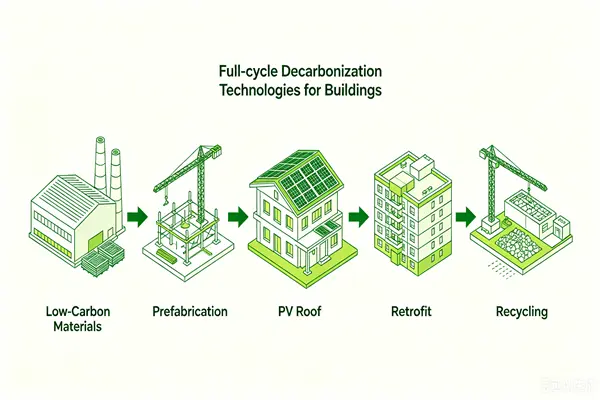
Addressing the dual challenges of embodied and operational carbon emissions in the construction industry, this UN report comprehensively outlines feasible decarbonization technologies covering five key sectors: building material production, construction sites, building operations, renovation of existing buildings, and construction waste recycling. All technologies have undergone large-scale engineering verification and are adaptable to different construction scenarios in developed and developing countries. Layered implementation can rapidly reduce overall carbon emissions across the industry, providing governments and construction companies with a clear and actionable roadmap for emission reduction, cutting off the continuous release of greenhouse gases at its source.
Upstream, the building material production segment focuses on low-carbon material substitution and production process upgrades to significantly reduce the total embodied carbon emissions from buildings. Traditional cement is a key breakthrough point for embodied carbon emission reduction. Currently, there is a wide variety of mature, mass-produced low-carbon cements available. Limestone calcined clay cement (LC³) can be directly adapted to existing cement production lines without large-scale equipment modifications. Compared to ordinary silicate cement, it reduces carbon emissions by more than 40%, and its strength, waterproofing, and durability fully meet residential and infrastructure construction standards. It has already been put into use in large-scale construction projects in many cities around the world. Geopolymer concrete completely eliminates cement raw materials, using industrial solid waste such as fly ash, steel slag, and mineral slag as core raw materials. It does not require high-temperature kiln calcination, and its overall carbon emissions are only one-tenth of traditional cement. It is suitable for road base courses, underground utility tunnels, and large-scale foundation construction, simultaneously utilizing industrial solid waste and achieving cross-industry collaborative carbon reduction. Carbon-negative cement actively absorbs carbon dioxide from the air during the curing stage, achieving negative carbon emissions throughout its entire life cycle. Its production scale is continuously expanding, and it is expected to completely replace traditional cement products in the future. In the steel sector, short-process electric arc furnace steelmaking is being promoted, using scrap steel as a raw material to replace iron ore. The entire process eliminates the need for coke smelting, reducing carbon emissions by more than 75%. A global scrap steel recycling network is being established, and all scrap steel generated from building demolition is recycled, constructing a steel circular system. In the building structure sector, biomass building materials such as heavy timber and glued laminated timber are being promoted. Multi-story residential buildings and small to medium-sized public buildings can be entirely constructed using wood structures. The wood continuously absorbs carbon dioxide during its growth process, and production and processing require only light mechanical treatment, resulting in almost zero carbon emissions in the production process and significantly reducing cement and steel consumption. In addition, building material production kilns have been completely replaced with coal-fired and natural gas heat sources, and supporting photovoltaic power stations and direct purchase of green electricity are implemented in the factory area. All production processes use renewable electricity, further reducing carbon emissions during the building material manufacturing stage. Sand and gravel mining controls the excavation of natural mines and promotes the recycling of construction waste into sand and gravel, reducing greenhouse gases and ecological damage from mining.
Construction sites rely on new energy construction machinery and modular prefabricated construction to reduce temporary carbon emissions during the construction phase. Traditional construction sites extensively use diesel excavators, cranes, and dump trucks, with diesel combustion continuously releasing carbon dioxide. Now, with mature all-electric construction machinery technology, electric excavators, electric tower cranes, and electric dump trucks have sufficient range to meet all-day construction needs. Construction sites are equipped with mobile energy storage devices and photovoltaic charging piles, and the machinery operates entirely on green electricity, completely eliminating carbon emissions from fuel combustion on construction sites. Prefabricated construction involves prefabricating building components such as walls, floor slabs, and stairs in a factory, then transporting them to the construction site for direct assembly. Compared to traditional on-site casting, this reduces on-site work time by 70%, simultaneously reducing dust and the operating time of construction machinery, significantly lowering energy consumption during the construction phase. The factory prefabrication workshops are equipped with energy-efficient production lines, resulting in lower energy consumption for component production compared to on-site casting, thus doubly reducing carbon emissions throughout the entire construction process. Optimized delivery routes for construction materials, centralized bulk transport to reduce vehicle trips, and the use of electric trucks for short-distance material transfers, along with the use of insulated composite panels for all temporary on-site office buildings and the provision of small photovoltaic panels for office lighting, comprehensively reducing scattered carbon emissions at the construction site. Simultaneously, construction companies implement refined material management, accurately calculating material usage to reduce waste of cement, steel, and tiles, keeping material loss rates below 3%, indirectly reducing the demand for building materials and thus reducing upstream carbon emissions from the demand side.
During the building operation phase, upgrades to the building envelope, the availability of clean energy, and digital intelligent management continuously reduce operational carbon emissions over decades of service life. Building envelopes are the foundation for temperature control and energy conservation. New buildings are mandated to have external wall insulation layers and roof insulation panels, and windows are replaced with triple-glazed Low-E energy-saving glass to reduce indoor-outdoor heat exchange. This directly reduces the operating load of air conditioning and heating systems by more than 40%, fundamentally reducing the electricity and gas consumption of temperature control equipment. Whole-house heating and cooling systems replace traditional gas boilers and old-fashioned air conditioners, and air-source and ground-source heat pump equipment is widely promoted. Heat pump equipment consumes 1 kWh of electricity to generate 3 to 4 kWh of heat, with energy utilization efficiency far exceeding that of traditional temperature control equipment. Cities with geothermal resources are equipped with centralized geothermal heating systems, completely eliminating the use of fossil fuels. Buildings are fully covered with photovoltaic modules on rooftops and facades, creating a building-integrated photovoltaic system. Daily lighting, elevators, and air conditioning in buildings prioritize the use of self-generated photovoltaic power, with excess electricity transmitted to the public grid, achieving building energy self-sufficiency. Large shopping malls and office buildings are equipped with energy storage battery packs to store daytime photovoltaic power generation and release electricity during peak evening hours, reducing the need to purchase electricity from thermal power plants and the power grid. A digital intelligent energy management system has been implemented in tandem, with sensors collecting real-time data on indoor temperature and equipment power consumption. AI algorithms automatically adjust the operating power of air conditioning and lighting equipment, automatically turning off lights and reducing air conditioning load in unoccupied areas to prevent energy waste caused by equipment idling. Public buildings are implementing room temperature control standards, with air conditioning temperatures not lower than 26 degrees Celsius in summer and heating temperatures not higher than 20 degrees Celsius in winter, relying on institutional constraints to reduce ineffective energy consumption.
Globally coordinated efforts to promote building decarbonization solutions
While releasing its industry carbon emissions report, the United Nations Environment Programme (UNEP) launched a comprehensive collaborative action plan for governments worldwide, international financial institutions, and building industry associations. This plan covers four dimensions: regulatory and policy constraints, green finance support, industry technology cultivation, and international transnational cooperation. It balances short-term mandatory control measures with long-term industry development plans, addressing four key aspects: policy, funding, technology, and market. This plan aims to resolve core obstacles in the current decarbonization process, such as insufficient policy support, significant financial pressure on enterprises, a shortage of low-carbon technology production capacity, and inconsistent actions among countries. It seeks to accelerate the global construction industry's decarbonization process in a synchronized manner, achieving the climate goals of the Paris Agreement on schedule.
Governments worldwide are improving their mandatory low-carbon building regulations, establishing a hard-line framework for industry decarbonization, and closing loopholes in the creation of new high-carbon buildings. The UN has provided a clear timetable for the implementation of these regulations: high-carbon-emission industrialized countries must introduce nationally unified mandatory zero-carbon building standards by 2028, while other developing countries must implement these standards by 2035 at the latest. All new residential, public, and infrastructure projects must strictly adhere to these standards; projects that fail to meet the standards will not be issued construction permits or completion certificates. Zero-carbon building standards clearly stipulate the thermal insulation indicators for the building envelope, the proportion of clean energy installed capacity, and the upper limit of carbon footprint in building materials for new buildings. They mandate full life-cycle carbon emission accounting during the project design phase and prioritize the use of low-carbon cement, recycled aggregates, and wood structures.
For existing older buildings, phased renovation regulations have been introduced, setting deadlines for the renovation of old urban buildings. Commercial office buildings, hospitals, schools, and other public buildings are given priority for energy-saving renovations. Buildings failing to complete renovations by the deadline will be subject to excess carbon emission taxes, compelling property owners to initiate renovation projects. Simultaneously, a building carbon emission certification system will be established, benchmarking against LEED and domestic green building evaluation standards, establishing a tiered green building certification system. Government-invested public buildings must obtain the highest level of zero-carbon building certification. Real estate developers who obtain high-level green certification can enjoy policy incentives such as increased floor area ratios and expedited approval processes. This two-way reward and punishment mechanism guides the market to proactively favor low-carbon buildings. The building materials sector has introduced regulations for low-carbon building material labeling, requiring all cement, steel, and glass products to display unit carbon emission values on their packaging. Government procurement projects prioritize low-carbon labeled building materials, limiting the share of high-carbon building materials in government procurement. This demand-side incentive forces building material companies to upgrade their production lines and replace processes with low-carbon technologies.
Global financial institutions have launched dedicated green finance tools to alleviate the financial pressure on construction companies regarding low-carbon retrofitting and low-carbon building material production. Multinational financial institutions such as the World Bank, the Asian Infrastructure Investment Bank, and the European Bank for Reconstruction and Development have established special loan pools for building decarbonization, specifically for the expansion of low-carbon building material production lines, energy-saving renovations of old residential areas, and zero-carbon housing development projects. These loans offer annual interest rates 2 to 3 percentage points lower than ordinary commercial loans, extend repayment periods, and significantly reduce the upfront capital investment pressure on companies. Domestic commercial banks in various countries have simultaneously launched green building mortgage loans. Residents purchasing zero-carbon or ultra-low-energy housing face lower down payment ratios and preferential loan interest rates, encouraging homebuyers to actively choose low-carbon properties and stimulating demand in the green building market.
Green bonds and carbon neutrality-specific bonds are fully open to low-carbon building projects. Building material companies expanding low-carbon cement production lines and real estate companies developing zero-carbon communities can issue green bonds to raise funds. Bond investors enjoy tax breaks and exemptions, broadening project financing channels. The carbon trading market incorporates carbon emission allowances for the construction industry. Building material companies and large real estate developers are allocated annual carbon emission allowances. Companies can sell any emission reductions exceeding their allowances on the carbon market to generate revenue. Companies exceeding their carbon emission standards must purchase additional allowances, forming a market-based incentive and constraint mechanism for emission reduction. Some developed countries are piloting building energy efficiency mortgage loans. After energy-saving renovations of older buildings, the property value increases, and owners can use the increased value to apply for low-interest loans to cover renovation costs and reduce residents' financial concerns about renovations. International climate finance fulfills its aid commitments, with developed countries allocating special climate funds to developing countries annually for establishing local building energy efficiency standards, constructing low-carbon building material factories, and training grassroots building technicians, narrowing the gap in building decarbonization infrastructure between developed and developing countries.
Conclusion
The decarbonization of the construction industry offers dual benefits: climate advantages and economic gains. New zero-carbon buildings and energy-efficient renovations of older homes can significantly reduce long-term electricity and heating costs for residents. The low-carbon building materials industry and the building energy-saving renovation market will spawn a trillion-dollar new industry, creating numerous high-end technology jobs and driving the simultaneous development of upstream and downstream industries such as green building materials, photovoltaic equipment, and intelligent energy management, achieving synergistic progress in climate protection and economic growth.
Currently, extreme heat, floods, droughts, and other climate disasters are frequent globally. The real impact of the climate crisis has permeated every city and every building worldwide. The construction industry accounts for nearly 40% of global carbon emissions, naturally becoming a core area for global climate governance. Governments, real estate companies, building material manufacturers, and the general public need to jointly participate in the low-carbon transformation of buildings. Governments should introduce rigid policies to guide the market, companies should proactively replace production processes with low-carbon technologies and develop green buildings, and the public should prioritize ultra-low-energy housing and actively participate in energy-saving renovations of older buildings, forming a unified consensus across society on building decarbonization.
Climate crisis knows no borders. The warming impact of high carbon emissions from the construction industry will spread to all regions of the world. Only when countries around the world set aside their development differences, simultaneously implement the UN's decarbonization action plan for buildings, open up channels for emission reduction throughout the entire life cycle of buildings, and steadily reduce the industry's carbon emission share by 37%, can we effectively slow down the rate of global warming, safeguard the 1.5-degree Celsius global warming limit of the Paris Agreement, create low-carbon, livable, and climate-resilient urban built environments for billions of people around the world, and promote human society to a new stage of sustainable and low-carbon development.
Disclaimer: The information published on this website is sourced from the internet and does not represent the views of this website, nor does it guarantee the accuracy of its content. Please be aware of the distinction. Furthermore, the products provided by our company are for scientific research purposes only. We are not responsible for any consequences arising from improper use. If you are interested in our products, have any criticisms or suggestions regarding our articles, or are not completely satisfied with the products you received, please contact us by email: allen@faithfulbio.com; our team is dedicated to ensuring complete customer satisfaction.