

The Russian central bank cut interest rates to 15%, but why are global economic cycles going their separate ways?
On March 20, 2026, the Central Bank of Russia announced a 50 basis point cut to its key interest rate, bringing it to 15%. This marks the seventh consecutive rate cut since June 2025 and the second cut in 2026.
This decision comes against the backdrop of major central banks worldwide maintaining a generally hawkish stance. Just days earlier, the Federal Reserve, the European Central Bank, and the Bank of England all decided to hold rates steady in their mid-March interest rate decisions—the core reason being the escalating tensions in the Middle East leading to soaring energy prices and a renewed rise in global inflation risks.
With Russia continuing its counter-cyclical rate cuts while major developed economies remain on hold or even consider raising rates, the "inconsistency" in the global economic cycle has never been so pronounced. So the question arises: why are central banks no longer acting in unison?
Why does Russia dare to "go against the grain"?
The Russian central bank's interest rate cut was not a spur-of-the-moment decision, but rather based on a series of clear economic considerations.
First, a window of opportunity has opened for a slowdown in inflation. Data shows that as of March 2026, Russia's annual inflation rate was 5.9%. The Russian central bank predicts that the full-year inflation rate for 2026 will fall to 4.5% to 5.5%, and will approach 4% in the second half of 2026. This provides policy space for an interest rate cut.
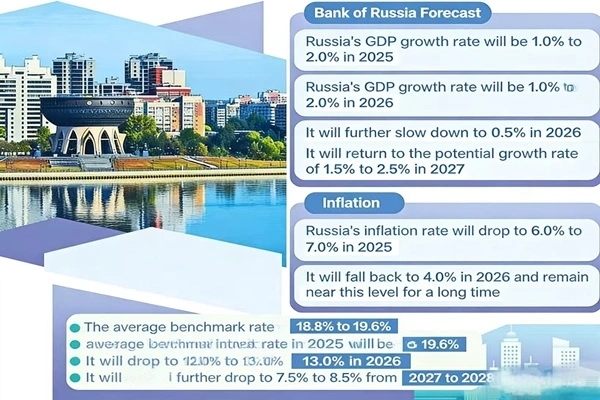
Second, economic pressures are beginning to emerge. Russia's GDP declined in January 2026, and business confidence indices in almost all sectors continued to fall. Russian central bank governor Nabiullina admitted, "Economic activity in the first quarter remained below expectations." Under the heavy pressure of high borrowing costs, corporate financing costs continue to rise, and investment and consumption may be suppressed—if economic growth fails to recover while prices continue to rise, a typical stagflation situation could emerge.
Third, "maintaining growth" takes precedence over "fighting inflation." Some analysts point out that the Russian central bank is attempting to maintain a delicate balance between inflation resilience, economic slowdown, and fiscal pressure. While this rate cut signals a possible easing of monetary policy, uncertainties surrounding inflation expectations and the external environment still limit the scope for further policy adjustments. Nabiullina emphasized that the rate cut is part of a "smooth and balanced" approach, with the goal of gradually bringing the inflation rate back to the 4% policy target.
Why are developed economies "afraid to act"?
In stark contrast to Russia, developed economies are generally caught in a dilemma.
The Federal Reserve: A double constraint of sticky inflation and resilient employment. In 2026, the US economy exhibits a significant "K-shaped" divergence: economic output remains resilient, with real GDP far exceeding pre-pandemic trends, but labor demand has leveled off. This divergence reflects the impact of AI-driven rapid productivity gains—companies are increasingly able to expand their operations without significantly increasing their workforce. Meanwhile, inflation remains stubborn, with significant cumulative increases in food, energy, and housing prices. Federal Reserve Governor Barr explicitly stated that "interest rates may need to remain unchanged for some time."
The European Central Bank: The risk of stagflation is quietly approaching. ECB Governing Council members acknowledged that "the risk of stagflation does exist," and the market has fully priced in the expectation of three rate hikes this year. In 2026, EU economic growth is projected to slow to 1.3%, while inflationary pressures persist. Starting in 2026, the EU will impose a "carbon border tax" on products such as steel, cement, aluminum, and fertilizers, which could further push up prices in some sectors.
The UK: Fiscal Dilemma and Political Constraints. The UK serves as a cautionary tale for fiscal distress among developed economies. The government is burdened with heavy debt, yet attempts to cut spending have repeatedly met with political resistance. The latest budget is expected to drag down economic activity, with unemployment already at a post-pandemic high of 5.1%, while inflation remains at 3.2%, well above the central bank's 2% target.
Why are global cycles no longer synchronized?
In the past, major central banks around the world often acted in unison, easing or tightening policies together. However, this synchronization is breaking down in 2026. What are the reasons for this?
First, the causes of inflation differ. Inflation in developed economies is mainly driven by overheated demand and rising energy prices, while inflation in Russia is more a result of supply-side structural factors and the depreciation of the ruble. Geopolitical conflicts in the Middle East are pushing up energy prices, which could bring both imported inflationary pressures and disruptions to export logistics for Russia. The Russian central bank assesses that the risk of inflation is greater than the risk of inflation suppression.
Second, economic structural divergence is widening. Emerging markets and developing economies will continue to be important engines of global growth. A World Bank report shows that emerging markets and developing economies will drive global economic growth at 4.2% in 2025, and are expected to remain above 4.0% in 2026 and 2027. Meanwhile, developed economies are experiencing weak overall growth; the IMF predicts that developed economies will grow by only 1.8% in 2026.
Third, there are significant differences in policy space. As of the first half of 2025, global debt had reached a record high of $337.7 trillion. Developed countries' debt remains stubbornly high, with the US federal debt approaching $39 trillion, exceeding 120% of GDP. In contrast, some emerging markets possess greater policy flexibility—although many developing countries face the risk of debt repayment disruptions.
Fourth, geopolitics is reshaping the economic landscape. The World Economic Forum's "Global Risks Report 2026" indicates that geoeconomic confrontation is the primary risk in 2026. Uncertainty surrounding US tariff policy, the implementation of the EU's carbon border tax, and the accelerated restructuring of global supply chains—these factors are pushing countries onto different policy paths.
2026: A Fragmented World, Strategies for Fragmentation
According to forecasts from multiple international institutions, global economic growth is projected to slow to approximately 3.0% in 2026, potentially marking the fifth consecutive year of slowdown since the COVID-19 pandemic.
For investors and policymakers, this signifies a profound shift: the old "one-size-fits-all" macroeconomic thinking is outdated. The US, Europe, Japan, China, and Russia—each face different inflationary pressures, different growth bottlenecks, and different policy spaces.
As Russian Central Bank Governor Nabiullina stated, interest rate cuts are not guaranteed at the next meeting. This cautious "wait-and-see" approach precisely reflects the essence of the current global economic cycle: there is no unified script, only individual predicaments.
As the world economy faces a "rebalancing under restorative growth," the policy divergence among central banks not only reflects economic reality but may also become the norm in the global economic landscape for the next few years. For businesses and investors, understanding and adapting to this divergence may be more important than predicting the next round of global easing.
Disclaimer: The information published on this website is sourced from the internet and does not represent the views of this website or confirm the accuracy of its content. Please be aware of the distinctions. Furthermore, the products provided by our company are for scientific research purposes only. We are not responsible for any consequences arising from improper use. If you are interested in our products, have any criticisms or suggestions regarding our articles, or are not entirely satisfied with the product you received, please contact us via email: allen@faithfulbio.com; our team is dedicated to ensuring complete customer satisfaction.