

How does NVP-BGJ398 precisely suppress cancer?
NVP-BGJ398, also known as Infigratinib, is a highly selective small molecule inhibitor of FGFR in the pyrimidine urea class. Compared with broad-spectrum inhibitors of multiple kinases on the market that have no differential effect, it has outstanding target discrimination ability, strongly blocking only FGFR1, FGFR2, and FGFR3 that induce tumor lesions, while having almost no inhibitory effect on FGFR4, which maintains normal organ development and cell metabolism, significantly reducing non-specific interference in experiments. Today, NVP-BGJ398 is used as a standard positive control tool in global research on the in vitro mechanisms of FGFR-mutant solid tumors and chondrodysplasia, three-dimensional organoid modeling, and targeted drug activity screening.
🧬 Molecular backbone adapted to target protein
NVP-BGJ398 possesses a regular and stable pyrimidine urea heterocyclic backbone with the complete molecular formula C₂₆H₃₁Cl₂N₇O₃ and a relative molecular mass of 560.48. The molecule contains no chiral carbon atoms, preventing the formation of stereoisomers that could interfere with experimental results. Its uniform and regular spatial configuration ensures stable efficacy from the molecular level. Many common targeted small molecules suffer from insufficient chemical bond toughness, leading to side chain breakage and ring structure hydrolysis after long-term low-temperature storage or prolonged cell incubation, resulting in a continuous decline in efficacy. In contrast, this product has a sufficiently rigid backbone, free of easily oxidized or hydrolyzed weak groups. It maintains its intact active structure even after 28 months of conventional light-protected low-temperature storage, making it suitable for long-term tumor drug resistance model construction experiments.
The pyrimidine urea core at the molecule's center is the core functional region for target binding. The nitrogen and oxygen atoms distributed on the core surface can form a multi-layered hydrogen bond network with amino acids in the FGFR kinase hinge region, tightly embedding within the kinase's dedicated ATP-binding cavity. The stronger binding force resulting from multi-layered hydrogen bonds allows the molecule to remain attached to the target protein for a longer period, preventing rapid detachment after brief binding and achieving stable inhibitory effects even at nanomolar concentrations. Utilizing this unique binding structure, the molecule can precisely distinguish between different subtypes of the FGFR family, avoiding indiscriminate binding to other intracellular homologous kinases and reducing off-target interference signals at the structural level.
The NVP-BGJ398 molecule features a dichlorodimethoxy aromatic benzene ring in its middle segment, filling the dedicated hydrophobic groove on the outer side of the kinase and further strengthening the bond between the molecule and the target protein. Mutated oncogenic FGFR1/2/3 cavities contain elongated hydrophobic regions, a structure absent in the normally functioning FGFR4. The benzene ring, through hydrophobic interactions and π-π stacking effects, firmly embeds itself in the groove, enhancing overall inhibitory activity and giving the molecule a natural subtype selection capability. It can distinguish between diseased and normal kinases without additional modification, significantly reducing experimental background noise.
The hydrophilic ethylpiperazine side chain at the molecule's terminal end balances the overall lipid-water partitioning properties, solving the dual challenges of pure heterocyclic molecules being poorly soluble in culture media and pure hydrophilic structures being unable to penetrate cell membranes. The hydrophobic core ensures the molecule can smoothly pass through the lipid cell membranes of tumor and chondrocytes, while the hydrophilic piperazine side chain allows the molecule to be uniformly dispersed in complete cell culture media. When preparing high-concentration working solutions, there will be no precipitation, stratification, or aggregation, enabling smooth operation in high-throughput drug screening and large-scale simultaneous cell incubation.
⚙️ Targeted blocking of abnormal proliferation pathways
Under normal physiological conditions, the FGFR family of kinases possesses a sophisticated self-regulating mechanism, activating only briefly during tissue repair and bone growth. They strictly control the rhythm of cell division and differentiation, preventing continuous signal output. This entire signaling pathway involves multiple positive and negative feedback regulation, balancing cell proliferation rates and ensuring the stable development of tissues such as the liver, bones, and blood vessels. It prevents disordered cell proliferation and disease, making them indispensable signaling proteins for maintaining homeostasis.
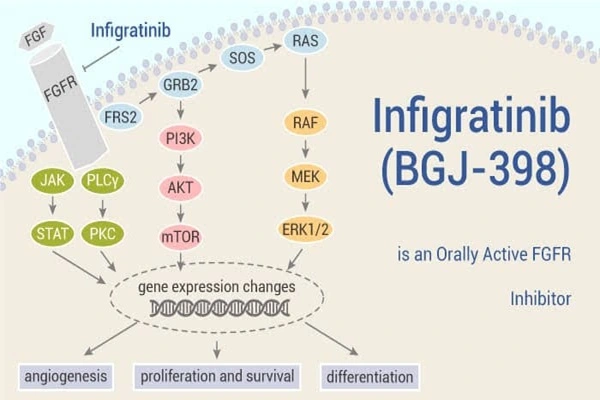
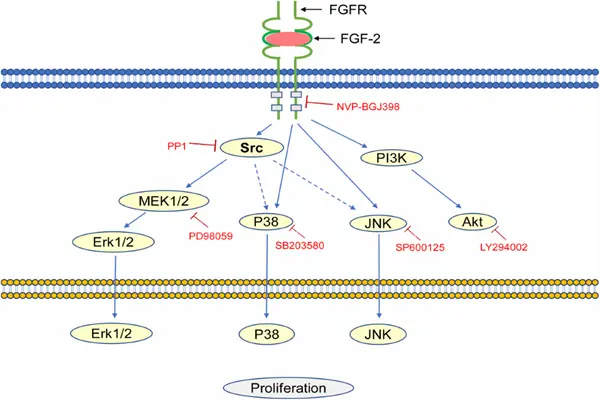
When cells undergo gene fusion or site mutation, FGFR1, FGFR2, and FGFR3 completely lose their regulatory capacity. They can phosphorylate autonomously and continuously without external growth factor stimulation, continuously transmitting proliferation, angiogenesis, and cell migration signals downstream. This uncontrolled signaling chain progressively activates multiple oncogenic pathways, including ERK, PLCγ, and STAT, directly driving the unlimited clonal expansion of tumor cells, inducing massive angiogenesis around the lesion for nutrition, and simultaneously enhancing the invasive and metastatic capabilities of tumor cells. The pathogenesis of diseases such as cholangiocarcinoma, mutant lung cancer, and chondrodysplasia is highly correlated with these abnormal pathways.
NVP-BGJ398 exerts its inhibitory effect through a competitive site-occupancy mechanism. After entering the cell, the small molecule migrates directionally to the active site of the FGFR kinase, completely displacing the binding site of endogenous ATP. ATP is the only energy carrier for the phosphorylation reaction of the kinase; with the binding site blocked, the kinase completely loses its ability to catalyze the activation of downstream proteins, directly cutting off the core signaling chain of tumor proliferation at its source. This direct site-occupancy mechanism of action is highly specific, does not interfere with other basic cellular energy metabolism, and is effective only against mutated FGFRs, resulting in fewer experimental confounding factors and higher data purity.
With sustained drug action, multiple overactivated downstream oncogenic pathways synchronously become quiescent, the tumor cell division cycle is arrested in a quiescent phase, and the malignant state of unlimited proliferation is effectively curbed. Simultaneously, abnormal proliferation of vascular endothelial cells is inhibited, angiogenesis around the lesion is significantly reduced, the tumor's nutrient supply is cut off, the epithelial-mesenchymal transition process is blocked simultaneously, and the tumor cells' ability to invade surrounding tissues and metastasize to distant organs is weakened. It controls tumor progression from multiple dimensions—proliferation, blood supply, and spread—with a comprehensive and balanced effect.
🧫 Covers multiple scientific research experimental scenarios
NVP-BGJ398 is a standard positive control material for FGFR-mutant solid tumor research, with its core applications in the construction of in vitro cell and three-dimensional organoid models of mutant tumors. Clinically prevalent FGFR2 fusion cholangiocarcinoma, FGFR1/3 mutant lung cancer, bladder cancer, and gastric cancer all require stable, highly selective inhibitors as a reference to validate pathway function and the efficacy of novel compounds. This product, with its stable nanomolar inhibitory activity and extremely low impurity interference, is widely used in cell proliferation experiments, colony formation assays, scratch migration assays, and three-dimensional tumor spheroid culture. It can stably reverse malignant tumor phenotypes and establish standardized in vitro research systems for diseased cells.
NVP-BGJ398 can be used in developmental biology research related to skeletal development and is a core tool for exploring the mechanisms of chondrodysplasia. Most chondrodysplasia diseases are caused by persistent overactivation of FGFR3. Abnormal signals inhibit chondrocyte proliferation, hinder longitudinal bone growth, and ultimately cause skeletal malformations. NVP-BGJ398 can precisely suppress overactive FGFR3 signaling, restoring the normal proliferation and differentiation rhythm of chondrocytes. Researchers have leveraged this property to build in vitro bone defect repair models, elucidate the regulatory mechanisms of bone growth, and screen for active small molecules with bone repair effects.
In research on the tumor microenvironment and anti-angiogenesis, this product has irreplaceable value. Sustained tumor growth and distant metastasis highly depend on nutrient delivery to newly formed blood vessels in the lesion, and abnormal activation of FGFRs is a key pathway driving vascular endothelial proliferation. Intervening in endothelial cells with this product can effectively block endothelial cell proliferation, migration, and tubular structure formation, inhibiting tumor angiogenesis. It is frequently used to explore starvation-induced anti-tumor mechanisms, regulate the tumor microenvironment, and screen anti-angiogenic lead molecules, providing comprehensive experimental support for the development of combined tumor intervention programs.
All novel FGFR-targeting lead molecule development uniformly uses NVP-BGJ398 as the efficacy reference benchmark. Global pharmaceutical companies and research laboratories developing various heterocyclic small molecules, targeted peptides, and prodrug derivatives all require horizontal comparison with this product in key indicators such as target affinity, subtype selectivity, tumor suppressor activity, cytotoxicity, and membrane penetration. Stable and consistent efficacy and highly reproducible experimental data make NVP-BGJ398 a universal standard for molecular structure-activity analysis, initial drug screening, and iterative optimization of molecular structures, supporting the continuous upgrading and iteration of FGFR-targeted drugs.
🔬 Molecular optimization and upgrading development direction
Side-chain targeted modification is currently the mainstream approach for molecule optimization, with a focus on the terminal ethylpiperazine hydrophilic side chain. While the original molecule exhibits good cell penetration, its active accumulation at tumor lesions is limited, requiring higher concentrations to achieve the desired anti-cancer effect. By branching tumor-specific affinity short peptides and glucose-targeting fragments onto the side chain, the modified derivative can actively accumulate at FGFR-mutant tumor lesions, increasing local drug concentration and achieving equivalent inhibitory effects at lower doses. This also reduces the slight off-target effects caused by systemic free drug, meeting the development needs of low-dose, long-acting tumor intervention models.
Tumor-acidic microenvironment responsive prodrug modification is a popular optimization route in recent years, primarily addressing the slight interference from normal cells caused by uniform systemic distribution of the molecule. The research team has incorporated a breakable pH-sensitive masking group onto the active heterocyclic backbone to synthesize a tumor microenvironment-specific activating prodrug. The modified molecule exhibits no target-binding activity in neutral blood or normal tissue cells, thus not interfering with normal cell metabolism. Only upon entering weakly acidic tumor lesions does the masking group automatically cleave, releasing the active NVP-BGJ398, achieving lesion-specific efficacy and further enhancing molecular specificity, aligning with the trend of low-toxicity, precision-targeted drug development.
Multi-pathway hybrid molecule splicing expands the boundaries of this product's pharmacological action, overcoming the limitations of single FGFR inhibitory functions. Tumor pathogenesis involves the disruption of multiple pathways, including proliferation, anti-apoptosis, local inflammation, and angiogenesis. Blocking a single target is insufficient to completely halt disease progression. Researchers covalently spliced the core FGFR inhibitory backbone of this product with pro-apoptotic, anti-oxidative stress, and anti-inflammatory active fragments to create a multi-functional hybrid small molecule. This simultaneously achieves a triple effect of blocking oncogenic pathways, inducing tumor cell apoptosis, and improving the lesion microenvironment, overcoming the limitations of single-target drugs and providing a new approach for the design of complex anti-tumor lead molecules.
Aromatic ring site-specific modification fine-tunes subtype inhibitory bias, adapting to the personalized research needs of different tumor models. The original molecule exhibits relatively balanced inhibitory intensity against the three subtypes of FGFR1, FGFR2, and FGFR3, while there are significant differences in the core driving subtypes of different solid tumors. Cholangiocarcinoma lesions are highly dependent on FGFR2, while lung cancer commonly shows FGFR1 and FGFR3 mutations. Site-specific modification of the mid-dichlorobenzene ring through fluorination and methylation can precisely adjust the binding affinity of the molecule for each subtype, creating derivatives with stronger subtype bias. This allows for targeted in vitro intervention experiments specifically tailored to different tumors, enabling precise subtyping and targeted research.
Conclusion
NVP-BGJ398 is the prototype molecule of a pan-FGFR inhibitor, with IC₅₀ values for FGFR1-3 ranging from sub-nanomolar to nanomolar, making it a benchmark tool for studying the role of the FGFR signaling pathway in tumors and bone diseases. As one of the first approved FGFR-targeted drugs, its clinical success in cholangiocarcinoma validates the therapeutic logic of pan-FGFR inhibition. Furthermore, its translational potential in newly discovered FGFR3-related chondrodysplasia is redefining this molecule from an "anti-cancer drug" to a "multi-indication pan-FGFR modulator."
Are you ready to find out how our NVP-BGJ398 will improve your product line? Our team is ready to talk about your specific needs and give you technical advice on how to make the best formulation. Email us at allen@faithfulbio.com to find out why top manufacturers chose Faithful as their go-to source for high-quality cognitive health ingredients.
References
- National Cancer Institute. (2026). BGJ-398 (CHEBI:63451). NCI Thesaurus.
- Guagnano, V., et al. (2011). Discovery of NVP-BGJ398, a potent and selective inhibitor of the fibroblast growth factor receptor family. Journal of Medicinal Chemistry, 54(20), 7066-7083.
- IUPHAR/BPS Guide to Pharmacology. (n.d.). Infigratinib (Ligand ID 7877).
- TargetMol. (n.d.). Infigratinib phosphate (T16364) product information.
- (2024). FGFR3 inhibitor NVP-BGJ398 reduces chondrodysplasia phenotype. Journal of Orthopaedic Translation, 44, 88-101.
- (2024). Targeting FGFR3 signaling and drug repurposing for SLC26A2-related chondrodysplasia. Journal of Orthopaedic Translation, 44, 88-101.