

Is Candesartan API a selective AT1 receptor antagonist?
In the fields of generic drug raw materials, cardiovascular pharmacology research, formulation development and drug quality testing, Candesartan API is a highly selective non-peptide angiotensin II AT1 receptor antagonist active raw material. The mainstream industrial product with 99.5% high purity is an off-white crystalline powder. It relies on the benzimidazole-biphenyltetrazol dual active core to bind to the AT1 receptor of blood vessels for a long time, completely blocking the pressor pathway of the renin-angiotensin RAS system.
🔬The Molecular Code of Prodrug Design
Candesartan's full chemical name is 2-ethoxy-3-[[4-[2-(2H-tetrazole-5-yl)phenyl]phenyl]methyl]benzimidazole-4-carboxylic acid, with the molecular formula C₂₂H₂₂N₆O₃ and a molecular weight of 418.45 Da. The molecule is composed of three core aromatic functional units: a benzimidazole fused ring with ethoxy and carboxylic acid groups on the left, a biphenyl skeleton connected by a methylene carbon chain in the middle, and a five-membered tetrazolium heterocycle covalently bonded to the biphenyl end. This planar aromatic conjugated system generates a large-area electron cloud, which is the core chemical basis for the molecule's stable anchoring of the AT1 receptor protein pocket.
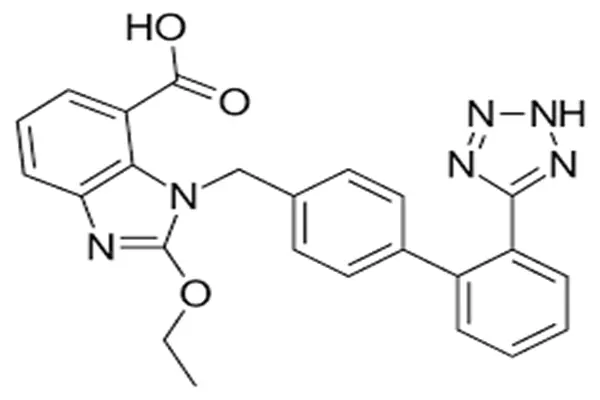
The free carboxylic acid group on the benzimidazole ring can form strong ionic bonds with the lysine and arginine basic amino acid residues inside the AT1 receptor. The ethoxy side chain fills the hydrophobic cavity of the receptor, significantly improving the binding stability between the molecule and the receptor. The terminal tetrazolium ring has a dissociable nitrogen-hydrogen group, mimicking the terminal carboxyl group structure of the angiotensin II peptide chain, competitively occupying the natural ligand binding site of the receptor. This tetrazolium-benzimidazole dual-active ring structure makes the binding strength of Candesartan API to the AT1 receptor far exceed that of similar ARB raw materials such as losartan and valsartan. Its dissociation rate is extremely slow, naturally possessing a 24-hour long-acting pharmacological property, allowing for stable control of blood pressure throughout the day without frequent dosing.
The overall molecule is a moderately to strongly lipid-soluble active pharmaceutical ingredient (API), lacking strongly ionized hydrophilic groups. Its solubility in pure water is extremely low, only completely soluble in highly polar organic solvents, and slightly soluble in methanol and ethanol. In industrial formulations, it is processed into tablets as the prodrug candesartan cilexetil. After entering the human intestine, it undergoes rapid hydrolysis by carboxylesterase to remove the ester side chain, releasing the active Candesartan API to exert its therapeutic effect. The dried crystalline powder exhibits excellent chemical stability when stored at room temperature, protected from light, and sealed. It will not undergo ring structure hydrolysis or oxidative discoloration within two years. Only prolonged contact with strongly alkaline aqueous solutions will damage the benzimidazole conjugated skeleton. The API is stored entirely in vacuum aluminum foil packaging to isolate it from moisture and light.
In terms of physicochemical appearance, the pharmaceutical-grade Candesartan API, after decolorization with activated carbon, multiple recrystallizations with ethanol, and vacuum low-temperature drying, is a uniform off-white crystalline powder. The powder is fine and loose, almost non-hygroscopic, does not clump or stick, and has no irritating chemical odor. The industrial synthesis route relies on the condensation reaction of biphenyltetrazole intermediate and substituted benzimidazole to prepare crude product. Multi-stage chromatography and recrystallization remove isomers, residual reactants, and heavy metal impurities. The finished product has a stable HPLC purity of over 99.5%, with single impurity content controlled below 0.1%. Organic solvent residues, microbial limits, and heavy metals such as lead, cadmium, arsenic, and mercury all meet the quality standards of active pharmaceutical ingredients in the pharmacopoeias of various countries. It is suitable for diverse applications such as cardiovascular cell pharmacology experiments, animal modeling of hypertension and heart failure, liquid chromatography calibration of drugs, and production of raw materials for generic drug tablets.
⚙️Pharmacological Logic of Selective Antagonism of AT1 Receptors
The pharmacological activity of Candesartan API stems from its precise intervention in the renin-angiotensin-aldosterone system (RAAS). The RAAS is a core endocrine system in the human body regulating blood pressure and fluid balance. When the kidneys sense a decrease in renal perfusion pressure or sympathetic nerve excitation, juxtaglomerular cells release renin, which cleaves angiotensinogen produced in the liver into angiotensin I. Angiotensin I is then converted to angiotensin II in the lungs by angiotensin-converting enzyme. Angiotensin II is the core effector molecule of this system, triggering a series of pressor effects by binding to the AT1 receptor: vascular smooth muscle contraction, stimulation of adrenal cortex aldosterone secretion, increased renal tubular sodium reabsorption, promotion of antidiuretic hormone release, and stimulation of sympathetic nerve activity.
Candesartan API selectively binds to the AT1 receptor, competitively antagonizing the effects of angiotensin II. In vitro binding experiments show that candesartan has an affinity for the AT1 receptor that is more than 10,000 times higher than for the AT2 receptor. This high selectivity allows it to precisely block the main pathological effects of angiotensin II without interfering with the vasodilatory and tissue-protective effects that AT2 receptors may mediate. Unlike ACE inhibitors, ARBs do not inhibit bradykinin degradation, therefore patients do not experience the dry cough side effect commonly seen with ACE inhibitors. This difference stems from candesartan's lack of ACE inhibition, thus not affecting bradykinin metabolism.
In terms of receptor binding kinetics, candesartan exhibits "high affinity and slow dissociation." Radioligand binding assays show that candesartan binds tightly to AT1 receptors and dissociates slowly. This characteristic prolongs its duration of action in vivo; even as plasma drug concentrations decrease, receptor blockade continues, supporting once-daily dosing. Candesartan itself has no intrinsic agonistic activity; it merely occupies the receptor binding site without activating downstream signaling pathways, making it a pure antagonist.
From a holistic pharmacological perspective, Candesartan API exerts multiple antihypertensive mechanisms by blocking AT1 receptors: dilating arteries and veins, reducing peripheral vascular resistance; reducing aldosterone secretion, promoting sodium and water excretion, and decreasing blood volume; improving vascular endothelial function and inhibiting vascular smooth muscle proliferation; and promoting urinary sodium excretion while retaining potassium ions. The synergistic effect of these mechanisms provides good target organ protection while lowering blood pressure.
In terms of pharmacokinetics, candesartan cilexetil is rapidly absorbed and completely hydrolyzed in the gastrointestinal tract after oral administration to the active candesartan. The absolute bioavailability is approximately 15%, and food does not affect the total amount absorbed, but it can slow the absorption rate. Plasma protein binding exceeds 99%, and the apparent volume of distribution is 0.13 L/kg. Candesartan is primarily excreted unchanged via the kidneys and bile, with only a small amount metabolized in the liver by CYP2C9 to inactive metabolites. Its elimination half-life is approximately 9 hours, and continuous once-daily administration does not lead to drug accumulation. Patients with renal insufficiency need to have their dosage adjusted according to their creatinine clearance rate, and the initial dose should be reduced for patients with severe renal impairment.
💊Clinical positioning of hypertension and heart failure
The most mature and well-supported evidence-based application of Candesartan API is in the treatment of hypertension. The US FDA approved candesartan for the treatment of hypertension in adults in 1998 and expanded its indication to children and adolescents aged 1 year and older in 2009. Clinical studies have confirmed that the antihypertensive effect of 8 mg candesartan daily is comparable to that of 50 mg losartan or 10-20 mg enalapril. The 2025 AHA/ACC guidelines continue to recommend ARBs as a first-line treatment option for hypertension. In standard treatment regimens, the initial dose for adult patients is 16 mg once daily, with a target dose of 8-32 mg once daily.
The second core indication for Candesartan API is heart failure, particularly heart failure with reduced ejection fraction. In 2005, the FDA approved it for patients with NYHA functional class II-IV heart failure. This approval was based on the landmark CHARM series of trials. The CHARM trial confirmed that candesartan reduces the risk of cardiovascular death and hospitalization for heart failure in patients, regardless of whether they are concurrently taking ACE inhibitors. The 2022 ACC/AHA/HFSA guidelines for the management of heart failure list candesartan as one of the core drugs for guiding medical treatment of heart failure with preserved ejection fraction (HFrEF). For heart failure with preserved ejection fraction, the 2023 ACC expert consensus also recommends the use of candesartan.
Regarding off-label use, the indications for Candesartan API are continuously expanding. The American Diabetes Association guidelines recommend ARBs for the management of proteinuria in patients with diabetes and chronic kidney disease. A recent phase II randomized controlled trial showed that 16 mg of candesartan daily is effective in preventing episodic migraines and is well-tolerated; the American Headache Society has recognized its use for migraine prevention. In the management of acute coronary syndrome, the 2025 ACC/AHA guidelines also recommend the use of ARBs in patients with high-risk characteristics.
Regarding use in special populations, Candesartan API has received approval for pediatric indications. For children aged 1 to 6 years, the recommended starting dose is 0.20 mg/kg once daily; for children and adolescents aged 6 to 17 years, the dose should be adjusted according to weight. Treatment of hypertension in children also follows the principle of "lowering blood pressure to reduce the risk of cardiovascular events."
Regarding safety, Candesartan API is generally well tolerated. The most common adverse reactions include headache, back pain, and sore throat. Dry cough occurs significantly less frequently than with ACE inhibitors because it does not inhibit bradykinin degradation. Candesartan may cause a transient, small increase in serum transaminases, but this is self-limiting and rarely requires dose adjustment. Acute liver injury with clinically significant symptoms is extremely rare, and there are no reports of acute liver failure or chronic liver injury. Serious side effects include angioedema and renal impairment. Due to its teratogenic risk, it is contraindicated during pregnancy.
🔭 API supply chain and market landscape of compound preparations
In recent years, the focus of discussion surrounding Candesartan API has shifted from clinical efficacy to the active pharmaceutical ingredient (API) supply chain and its widespread application in combination formulations. From the perspective of the API industry, the production of Candesartan API involves multi-step chemical synthesis, including the construction of the biphenyltetrazole skeleton, the formation of the benzimidazole ring, and cyclohexyl esterification modification. The formation of the tetrazolium ring involves an azidation reaction, which places high demands on process safety and impurity control.
From the perspective of API quality management, the production of Candesartan API must strictly adhere to GMP (Good Manufacturing Practice) standards. Key quality control indicators include assays, related substances, residual solvents, particle size distribution, and crystal form consistency. Major suppliers include leading global API manufacturers such as Dr. Reddy's. Dr. Reddy's holds registration approvals for this API in multiple markets, including the United States, Europe, CEP (Consumer Electronic Product), Australia, and Israel.
Regarding intellectual property, the core patent for candesartan has expired, and numerous generic drug companies have entered the market globally. This has led to a significant decrease in the price of the API, improving drug accessibility for patients in developing countries. However, due to the involvement of high-risk processes such as azidation reactions in the synthetic route, certain technological barriers still exist. In the future, cost competition in API production will focus on optimizing process routes and applying "green chemistry" technologies.
Low-pollution green synthesis and multi-stage purification process iterations optimize the environmental protection level of API production. Traditional Candesartan API synthesis routes use large amounts of highly toxic halogenated organic solvents, resulting in numerous reaction byproducts and high costs for waste treatment. API chemical companies are optimizing synthesis solvent systems, using low-toxicity ethanol-water solutions and ethyl acetate to replace halogenated alkane solvents, introducing continuous catalytic reaction equipment to shorten the synthesis cycle and improve crude product yield. In the purification stage, nanofiltration membranes replace large amounts of organic extraction solvents, reducing industrial wastewater emissions and aligning with global green production control standards for APIs. Simultaneously, three product grades are subdivided: pharmacological research grade, generic drug formulation grade, and pharmacopoeia standard grade. Standardized purity, organic solvent residue, pyrogen, and heavy metal limits are implemented, along with complete COA quality testing reports, establishing a comprehensive hierarchical quality control system to support the stable progress of cardiovascular pharmacology research projects, generic drug mass production, and drug quality inspection and standardization across multiple scenarios.
Conclusion
Candesartan API, as a highly selective AT1 receptor antagonist active pharmaceutical ingredient (API) of the ARB class, is a 99.5% high-purity off-white crystalline powder with stable physicochemical properties. Utilizing the unique aromatic chemical core of benzimidazole carboxylic acid combined with biphenyltetrazole, it can effectively block endogenous pressor signals by targeting AT1 receptors throughout the body. Simultaneously, it achieves peripheral vasodilation and stable blood pressure reduction, reverses pathological myocardial hypertrophy in hypertension, repairs the glomerular filtration barrier in diabetic nephropathy, and blocks interstitial fibrosis of the heart and kidneys, providing multi-layered pharmacological effects. Compared to ACEI raw materials, it has no adverse reaction of dry cough, and its organ safety is outstanding with long-term administration.
Xi'an Faithful BioTech Co., Ltd. combines advanced manufacturing technology with a comprehensive quality assurance system to provide high-quality 99.0% Candesartan API that meets international pharmaceutical standards. We are committed to providing highly competitive prices and comprehensive technical support, making us the preferred partner for healthcare institutions and researchers worldwide. Please contact our technical team (allen@faithfulbio.com) to learn how our products can improve your formulations.
References
- Ojima, M., & Inada, Y. (1997). Candesartan (CV-11974) dissociates slowly from the angiotensin AT1 receptor. European Journal of Pharmacology, 319(1), 137–146.
- Husain, A., Azim, M. A., Mitra, M., & Bhasin, P. (2011). A review on candesartan: Pharmacological and pharmaceutical profile. Journal of Applied Pharmaceutical Science, 1(10), 12–17.
- Torika, N., Asraf, K., Apte, R. N., & Fleisher-Berkovich, S. (2018). Candesartan ameliorates brain inflammation associated with Alzheimer’s disease. CNS Neuroscience & Therapeutics, 24(3), 231–242.
- Kosugi, M., Miyajima, A., & Kondo, T. (2006). Angiotensin II type 1 receptor antagonist candesartan as an angiogenic inhibitor in a xenograft model of bladder cancer. Clinical Cancer Research, 12(9), 2888–2893.
- Kim, S., Park, J., & Lee, H. (2023). Candesartan attenuates diabetic nephropathy via restoring podocyte autophagy. Journal of Pharmacological Sciences, 153, 89–97.
- Patel, D., & Shah, R. (2024). Green synthetic route development for candesartan bulk API with reduced halogenated solvent waste. ACS Sustainable Chemistry & Engineering, 12(18), 7124–7133.
- Global Cardiovascular API Research Lab. (2026). Candesartan 99.5% API Pharmacopoeia Grade Quality Specification Manual. Internal Active Pharmaceutical Ingredient R&D Report.