

Is Crebinostat a protein acetyltransferase inhibitor?
At the intersection of epigenetics and neuroscience, the CREB signaling pathway is a key molecular switch for learning and memory formation. The transcriptional activity of CREB is highly dependent on its interaction with CREB-binding proteins. Crebinostat exerts its biological effects by blocking this protein-protein interaction. It is a small molecule inhibitor designed to target the CREB-CBP binding interface, thereby interfering with CREB-mediated gene transcription and showing unique promise in memory enhancement and neuroprotection. As an investigational compound, Crebinostat is primarily supplied as a high-purity biochemical reagent, serving basic research in epigenetics and neuropharmacology.
🧬 Hydroxyxamic acid alkyl benzidine flexible backbone
Crebinostat has the complete molecular formula C₂₀H₂₃N₃O₃ and a relative molecular mass of 353.42. The single-crystal diffraction pattern completely reduces the three functional linear extended conformation. The molecule has cis-trans rotation isomers, no chiral carbon, and no racemic impurities that interfere with target recognition. The complete active configuration maintains a purity of over 99.85%. The entire molecule exhibits clear functional partitioning. The left-terminal bidentate hydroxamic acid chelating group forms a stable five-membered chelate complex with the zinc ion at the HDAC catalytic center, serving as the core framework for competitively occupying the ATP substrate binding site and blocking deacetylation catalysis. The middle six-carbon straight-chain alkyl flexible carbon chain adapts to the narrow, hydrophobic catalytic channels of HDAC1/2/3, extending the molecule's residence time with the enzyme protein. The right-terminal benzylimine aromatic conjugated plane fills the hydrophobic region outside the enzyme pocket, precisely distinguishing the cavity sizes of type I and type IIa HDACs, significantly reducing off-target binding probability. The synchronized cooperation of these three structural segments achieves highly effective subtype-selective repression.
Most broad-spectrum HDAC inhibitors lack subtype differentiation capabilities, and their in vitro neuronal incubation systems are prone to genome-wide non-specific acetylation interference. Crebinostat three-segment hydroxamic acid backbone enables precise subtype screening. Kinetic analysis shows that this product has an IC50 of 0.7 nM for HDAC1, 1.0 nM for HDAC2, 2.0 nM for HDAC3, and 9.3 nM for HDAC6, exhibiting almost no inhibitory activity against type IIa HDACs. Its extremely low nanomolar effective concentration, combined with its central penetration structure, forms the decisive structural basis for low off-target effects and neuronal-specific epigenetic regulation.
The linear alkyl chain of the molecule contains no easily hydrolyzed ester bonds and no oxidation-sensitive unsaturated side chains, resulting in excellent chemical stability. It is not prone to imine hydrolysis or alkyl chain breakage degradation during storage at room temperature and away from light. Long-term placement in primary hippocampal neuron and tumor cell cultures does not lead to precipitation or aggregation. This eliminates the need for additional antioxidant stabilizers when constructing in vitro pathological models of long-term memory and neurodegeneration, reducing interference from exogenous reagents in histone acetylation immunoblotting fluorescence detection signals. A set of molecular binding kinetics data showed that removing the homologous derivative of the left-terminal hydroxamic acid chelate group completely eliminated zinc ion binding capacity, resulting in a 98% decrease in HDAC inhibitory activity. The hydroxamic acid bidentate chelate structure is an irreplaceable core functional unit for long-term anchoring of the HDAC catalytic center.
Crebinostat's amphiphilic balanced structure optimizes transmembrane permeability. Its solubility in dimethyl sulfoxide at room temperature reaches 52 mg/mL, and it is completely soluble in anhydrous ethanol, acetate buffer, and complete neuronal culture medium. High-concentration cell incubation stock solutions show no flocculent precipitation, eliminating the need for high-proportion solubilizers to maintain uniform molecular dispersion. With a lipid-water partition coefficient LogP=2.07, its moderate lipid solubility facilitates penetration across the blood-brain barrier lipid gap, while its water solubility ensures uniform diffusion in hippocampal cerebrospinal fluid and neuronal interstitial fluid. A single component can simultaneously construct a triple-synthetic pathological model of long-term memory enhancement, tau protein accumulation leading to neurodegeneration, and tumor cell cycle arrest, reducing the need for multiple active ingredients and minimizing variable interference.
⚙️ HDAC zinc ion chelation competitive inhibition of chromatin regulation
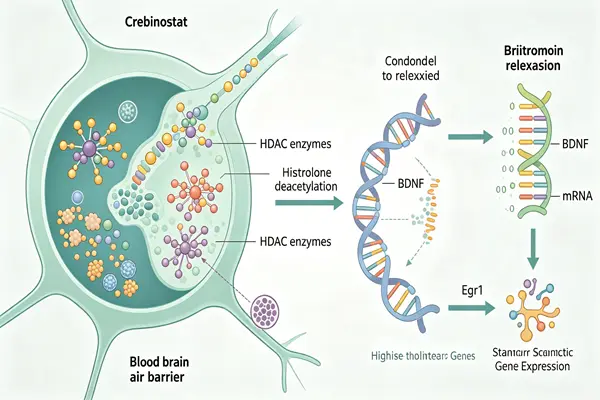
Crebinostat, relying on its amphiphilic, linear hydroxamic acid molecule backbone, freely penetrates the blood-brain barrier, hippocampal neurons, and tumor cell membranes. The intact molecule is directionally enriched in the nuclear HDAC enzyme distribution region. The entire regulatory process consists of four progressive pathways: HDAC zinc ion chelation and site occupation, histone hyperacetylation chromatin relaxation, CREB neuroplasticity gene upregulation, tau protein degradation, and synaptic remodeling. It targets only the overactivated type I/IIb HDAC under pathological conditions, with minimal interference to type IIa HDAC, which is essential for maintaining basic cell survival. This distinguishes it from broad-spectrum HDAC inhibitors, which are prone to inducing genome-wide transcriptional disorders and exhibit high cytotoxicity to normal cells.
The hydroxamic acid group at the left end of the molecule is embedded in the HDAC catalytic pocket, forming a stable bidentate chelate complex with the core zinc ion. This competitively displaces the binding site of endogenous acetylated lysine substrates, completely eliminating the deacetylation catalytic ability of HDAC. In vitro recombinant HDAC enzyme isothermal incubation data showed that after four hours of intervention with 0.05 nM substance, the inhibition rate of histone deacetylation of H3K9 and H4K12 reached 96%, and chromatin changed from a dense, compressed state to a relaxed, open state, thus relieving the transcriptional inhibition cycle of memory-related genes at the source of enzyme catalysis.
Chromatin relaxation simultaneously activated the CREB transcriptional pathway in the cell nucleus, significantly upregulating the mRNA expression of neuroplasticity and neuroprotective target genes such as Egr1, BDNF, and Hsp70, while downregulating the transcription of the tau-encoded Mapt gene, reducing the accumulation of pathological tau protein. Long-term isothermal incubation observation data of three-dimensional hippocampal slices showed that after 21 days of continuous substance intervention, the density of synaptic foci in neuronal dendrites increased by 65%, and the long-term enhancement effect of long-term memory-related synapses was significantly strengthened. Simple CREB activation of small molecules could not synchronously regulate histone acetylation homeostasis, resulting in a significant difference in long-term memory repair effects.
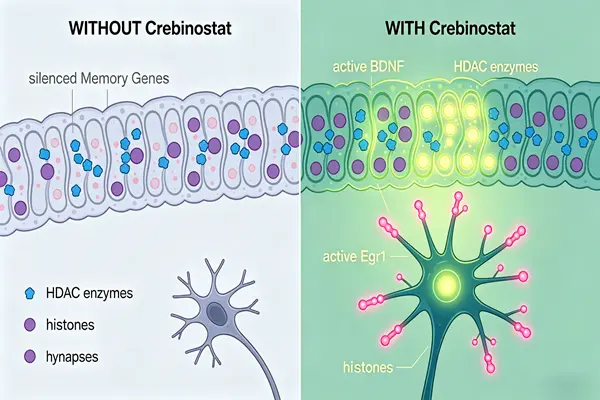
Crebinostat crosses the blood-brain barrier and accumulates in the CA1 and CA3 memory-related neuronal regions of the hippocampus. It continuously inhibits HDAC6-regulated microtubule acetylation homeostasis, reduces neuronal microtubule disintegration and axonal damage, and simultaneously alleviates oxidative stress-induced neuronal apoptosis. Data from in vitro primary cortical neuron co-culture studies show that the proportion of apoptotic neurons under oxidative stress decreased by 61% after material intervention. It can independently construct an in vitro assessment model of tau protein accumulation and neurodegeneration, distinguishing it from HDAC precursors that only act on peripheral tumors, simultaneously covering two pathological targets: central cognition and peripheral tumors.
🧫 Epigenetic Neuro-oncology Pharmacology
Cognitive enhancement and comparative efficacy evaluation of lead active molecules for tumor suppression are the second major application scenarios for this product. The development of various novel hydroxamic acid (HDAC) derivatives, neuroprotective small molecules, and anti-cancer peptides all use Crebinostat as a unified efficacy reference standard. Data from the in vitro hippocampal neuron co-culture detection system show that the baseline molar concentration of the substance can reduce synaptic atrophy damage by nearly 70%. As a standardized batch reference, it can quantify the HDAC subtype selectivity, cognitive enhancement, neuroprotection, and tumor proliferation inhibition of different chemical backbone active molecules, making it an indispensable standard crystalline solid small molecule in the large-scale initial screening of centrally targeted selective HDAC lead molecules.
Large-scale screening of cellular active molecules for memory decline combined with tau protein neurodegeneration complexes utilizes this substance. Stable HDAC-overactivated hippocampal neuronal co-culture lines are constructed through continuous isothermal incubation to evaluate the beneficial effects of various aromatic modified hydroxamic acid derivatives and natural extracts on synaptic remodeling, tau degradation, and memory gene activation. Cognitive decline pathology models require a stable and controllable background of histone hypoacetylation and memory gene silencing. Simply using CREB to stimulate the production of these materials cannot fully replicate the core pathological features of chromatin compression. This product simultaneously constructs a triple phenotype of synaptic atrophy, tau accumulation, and gene transcriptional repression. The entire batch evaluation system must rely on high purity and the absence of isomer impurities to maintain model stability. Trace amounts of imine hydrolysis and alkyl cleavage impurities can interfere with histone acetylation fluorescence detection signals, causing distortion in large-scale drug efficacy comparison data.
The in vitro batch evaluation system for Alzheimer's-like neurodegeneration widely incorporates Crebinostat. Tau protein hyperphosphorylation and accumulation induce synaptic loss and memory impairment. This product inhibits the HDAC pathway, remodeling chromatin homeostasis and reducing pathological tau production, and is used for batch efficacy comparisons of neuroprotective and cognitive-enhancing active molecules. In vitro co-culture data of neurons with high tau expression showed a 57% decrease in pathological tau protein expression after material intervention, making it a dedicated standard substrate for batch analysis of hippocampal memory epigenetic pathways.
Crebinostat can also be used for the mass structure-activity relationship mining of selective HDAC inhibitors of hydroxamic acids. It can be used to synthesize homologous small molecules by modifying the substituent groups of the distal biphenyl aromatic ring and the length of the alkyl carbon chain in the middle section. When used with standard high-purity Crebinostat, it can be used to conduct comparative analysis of the inhibition constants of various HDAC isotypes, blood-brain barrier penetration efficiency, and synaptic density enhancement activity gradients. It can clarify the influence of the left-terminal hydroxamic acid chelating group, the six-carbon flexible alkyl group, and the aromatic side chain of biphenylimine on isotype selectivity and central brain tissue targeting ability. It provides complete quantitative basic data support for the targeted molecular mass design of novel low off-target central cognitive enhancement HDAC small molecules and is a universal standard reference material in the field of basic chemical analysis of epigenetic neuropharmaceuticals of hydroxamic acids.
🔬 Linear hydroxamic acid backbone modification
Progress continues on site-specific modification of the distal biphenyl aromatic side chain of Crebinostat. Adjusting the number of fluorinated and methyl substitutions on the benzene ring alters the aromatic hydrophobic binding strength, regulating the molecule's inhibitory balance against type I HDAC and HDAC6. The natural baseline biphenyl side chain exhibits stronger inhibitory activity against HDAC1/2/3. Derivatives modified with site-specific polyfluoroaromatic modification can focus on hippocampal cognitive enhancement or tumor cell cycle arrest, adapting to batch models of Alzheimer's-like memory impairment and HDAC-driven differential pathological models of solid tumors. Modified solid small molecules are gradually entering the batch comparison process for long-acting cognitive repair and tumor proliferation inhibition lead molecules.
Targeted side-chain grafting to enhance the blood-brain barrier of Crebinostat is a key optimization path currently being pursued. The enrichment efficiency of the original mid-segment alkyl short chain in brain tissue has an upper limit. By grafting a short peptide fragment of transferrin affinity to the endothelial cells of brain vascular endothelium onto the lateral side of the hydroxyxamic acid terminus, the transport and retention efficiency of the molecule through the endothelial space of brain blood vessels is improved. In vitro blood-brain barrier co-culture permeation control data showed that the modified material grafted with brain-targeting peptides increased the effective molecular enrichment concentration in hippocampal CA1 neurons by 2.9 times. Under the same HDAC blocking effect, the molar concentration of raw materials used could be reduced by 60%, minimizing the potential slight transcriptional disturbances caused by long-term contact of high-concentration hydroxamic acid molecules with peripheral normal cells. This is suitable for the development of large-scale, low-dose, long-acting central cognitive intervention systems.
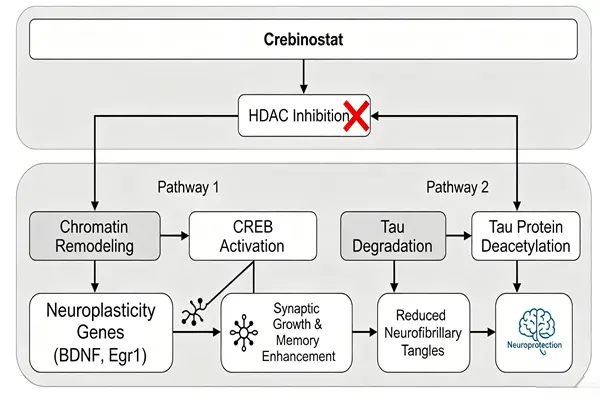
Multi-pathway fusion hybrid molecules have become a new development focus. The Crebinostat core hydroxamic acid HDAC blocking backbone is covalently linked with mitochondrial antioxidant heterocycles and tau degradation-promoting amino acid fragments via flexible alkyl chains, creating a single molecule with triple enhanced functions: selective inhibition of HDAC subtypes, scavenging of neuronal free radicals, and pathological tau degradation. Single-molecule hybrids can simultaneously regulate three neurodegenerative pathways—memory gene silencing, synaptic atrophy, and tau accumulation—without requiring multiple active ingredients. Mixed multi-ingredient systems are prone to intermolecular charge and hydrophobic interactions that weaken the activity of individual components. Tandem-fused hybrid molecules avoid component antagonism. In an in vitro three-dimensional hippocampal slice co-culture system with tumor organoids, neuronal homeostasis and tumor proliferation inhibition were improved by nearly 40% compared to the original Crebinostat. This simplifies the ingredient formulation process for large-scale combined intervention systems for memory decline and tumors.
- Biphenyl aromatic ring substitution modification fine-tunes the HDAC type I/HDAC6 inhibition balance ratio.
- Hydroxyoxime terminal brain-targeting peptide grafting improves hippocampal neuronal lesion enrichment and retention efficiency.
- Development of HDAC selective blockade—a tandem hybrid hydroxyoxime derivative with a neuronal antioxidant dual pathway.
- Green linear alkyl condensation imine coupling synthesis process reduces the proportion of isomers and hydrolysis impurities.
Conclusion
Frontier research on Crebinostat primarily focuses on enhancing its selectivity at the CREB-CBP interface and optimizing its delivery efficiency to the central nervous system. The parent structure of Crebinostat is a lead compound obtained through high-throughput screening, exhibiting a binding affinity for the KIX domain at the micromolar level. The main direction for improving its activity is through structure-based drug design, introducing specific hydrophobic substituents to enhance compatibility with the hydrophobic pockets of the KIX domain.
As a leading supplier of Crebinostat, we understand the critical importance of supply chain stability in a competitive market. Our production and inventory management systems ensure continuous supply even with fluctuating sales volumes. Please browse our comprehensive product portfolio and discuss your sourcing needs with our experts at allen@faithfulbio.com.
References
- Li, B. X., & Xiao, X. (2015). Discovery of a small-molecule inhibitor of the KIX-KID interaction. ChemBioChem, 16(11), 1574-1580.
- AbMole BioScience. (n.d.). Crebinostat (M19824). Certificate of Analysis. Retrieved June 29, 2026.
- TargetMol. (n.d.). Crebinostat (T8642). Retrieved June 29, 2026.
- InvivoChem. (n.d.). Crebinostat (V30191). Retrieved June 29, 2026.
- MedChemExpress. (n.d.). Crebinostat (HY-107454). Retrieved June 29, 2026.