
SLU-PP-332: A golden key to unlocking the "sports gene"
In the cutting-edge field of anti-aging and metabolic health research, scientists have always pursued a seemingly paradoxical dream—can a single pill simulate all the physiological benefits of exercise? This exploration, known as "exercise mimics," has recently welcomed a remarkable new member: SLU-PP-332. It is neither a natural extract nor a peptide hormone, but a completely artificially designed and synthesized small molecule compound. Although its molecular weight is only 290 Daltons, it can ignite a metabolic revolution in mice comparable to endurance training.
SLU-PP-332's "Precision Targeting Design"
SLU-PP-332 is a synthetic small-molecule nuclear receptor agonist. Its molecular structure is rationally designed based on the binding pocket of the ERR receptor, exhibiting high activity, high selectivity, and good drug-like properties. It is a classic example of structure-activity relationship optimization in pharmaceutical raw materials. Its molecular formula is C₁₈H₁₄N₂O₂, molecular weight is 290.32, CAS number is 303760-60-3, and it appears as a white to off-white crystalline powder. It is soluble in DMSO and ethanol, insoluble in water, and should be stored at -20°C protected from light.

SLU-PP-332's IUPAC name is (E)-4-hydroxy-N'-(naphthyl-2-methyl)benzoylhydrazine, with a core skeleton of benzoylhydrazine-naphthaldehyde hydrazone, which consists of three parts: ① 4-hydroxybenzoyl group (hydrogen bond donor/acceptor region): containing phenolic hydroxyl and amide bonds, it is a key polar group for binding to the ERR acceptor; ② hydrazine linker arm (-NH-N=CH-): flexibly connecting the two aromatic rings to maintain the conformational flexibility of the molecule; ③ 2-naphthyl group (hydrophobic binding region): a large conjugated aromatic ring that enhances the hydrophobic interaction with the ERRα binding pocket through π-π stacking. This structural design stems from the rational optimization of the ERR receptor: early ERR agonists were highly selective for ERRβ/γ but weakly active for ERRα. Studies have found that Phe328 in the ERRα binding pocket is the key site. By replacing the isopropylbenzene ring with a 2-naphthyl group, the strong π-π stacking of the naphthyl ring with Phe328 is achieved through the large conjugation system of the naphthyl ring. This results in SLU-PP-332 achieving an EC₅₀ of 98 nM for ERRα, which is 50 times higher than that of GSK4716. At the same time, it retains the agonistic activity for ERRβ (230 nM) and ERRγ (430 nM), thus becoming a pan-ERR agonist.
At the formulation development level, SLU-PP-332 exhibits good solubility in DMSO, but its solubility in aqueous solution is limited. This suggests that researchers need to employ appropriate solubilization strategies in animal experiments or future formulation development. Currently reported in vivo formulations consist of 10% DMSO, 10% Cremophor EL, and 80% PBS; this combination ensures effective systemic exposure after intraperitoneal injection.
The molecular structure of SLU-PP-332 perfectly exemplifies the principle of "structure determines function." Its biaromatic ring system provides a hydrophobic backbone identical to the ligand-binding pocket of the ERR receptor, while the hydroxyl and amide groups form stable interactions with the polar residues of the receptor through a network of hydrogen bonds. This ingenious molecular design allows it to simultaneously target the three subtypes of ERR: α, β, and γ—a breakthrough previously unachieved by many ERR agonists.
As a chemical reagent used in research, commercially available SLU-PP-332 typically requires a purity of ≥98%. For pharmaceutical raw materials, this purity standard is the basis for pharmacodynamic studies and safety evaluations. It is worth noting that the molecular weight of different batches of products may vary slightly due to differences in hydration levels, so this needs to be taken into account when performing precise dosage calculations.
A Broad Prospect from Metabolic Syndrome to Heart Failure
In the field of drug development, SLU-PP-332 currently occupies a unique position—it serves as both a "chemical probe" for exploring the biological function of ERR (Extracorporeal Receptor Ratio) and a "proof-of-concept molecule" for validating the therapeutic potential of ERR agonists. This dual identity gives it unique value in both basic research and translational medicine.
The most promising research direction for SLU-PP-332 is its application as a "motor mimic" in metabolic diseases. A study published in the *Journal of Pharmacology & Experimental Therapeutics* in 2024 showed that in diet-induced obese mice, SLU-PP-332 significantly improved several metabolic parameters: measured using a comprehensive laboratory animal monitoring system, SLU-PP-332-treated obese mice exhibited significantly higher energy expenditure at rest than the control group. This effect persisted even in a thermoneutral environment, suggesting that the drug directly activates metabolic regulatory pathways, rather than through thermogenesis.
The drug-treated mice showed a significant increase in fatty acid oxidation levels, consistent with its effect of reducing fat accumulation. Research data showed that the body fat content of mice in the SLU-PP-332-treated group was significantly lower than that in the control group. Both glucose tolerance tests and insulin sensitivity assessments showed that SLU-PP-332 treatment significantly improved glucose metabolism in obese mice. qPCR analysis of tissue samples showed that SLU-PP-332 treatment upregulated the expression of multiple genes involved in fatty acid oxidation and mitochondrial function, including PGC-1α and ERR target genes.
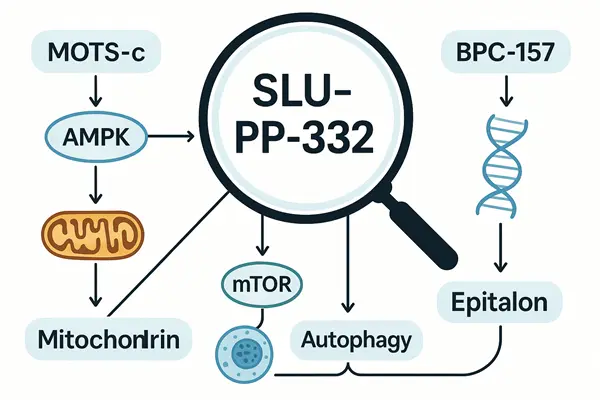
The core evidence for SLU-PP-332 as a sports mimic comes from its effects on exercise endurance. In a study published in *ACS Chemical Biology*, researchers reported that wild-type mice treated with SLU-PP-332 were able to run approximately 70% more distance and time on a treadmill than the control group—an effect comparable to mice that underwent a month of endurance training—without any exercise intervention. Even more remarkably, the study found that SLU-PP-332 induced the same gene expression program as acute endurance exercise, particularly the expression level of DNA damage-induced transcript 4, which reached or even exceeded the levels induced by running after drug treatment.
SLU-PP-332 “activates metabolic” molecular pathways
The mechanism of action of SLU-PP-332 is the specific activation of ERRα/β/γ nuclear receptors, regulating the expression of energy metabolism genes. Its pathway is clear and its target is well-defined, representing a classic mechanism of action for nuclear receptor-targeted drugs. From a pharmaceutical raw material perspective, its mechanism of action is the core basis for optimizing the structure of the active pharmaceutical ingredient, enhancing efficacy, and reducing side effects.
The ERR family belongs to the nuclear receptor superfamily, containing three subtypes: α, β, and γ. It can be activated without estrogen ligands, but its activity is significantly enhanced after binding to co-activators (such as PGC-1α). ERRα is actively expressed in skeletal muscle and adipose tissue, regulating fatty acid oxidation and mitochondrial function; ERRγ is actively expressed in the liver and heart, regulating lipid metabolism and oxidative phosphorylation; ERRβ is expressed sparingly in most tissues, and its effect is negligible. SLU-PP-332 exhibits the highest selectivity for ERRα, 2.3 times that of ERRβ and 4.4 times that of ERRγ, while being inactive against ERα/β, demonstrating high target selectivity.
From novel molecular design to translational medicine challenges
Breaking through the bottleneck of oral bioavailability
The biggest technical bottleneck for SLU-PP-332 lies in its oral bioavailability. Almost all published animal studies currently use intraperitoneal injection, twice daily, which clearly cannot meet the needs of long-term clinical use. Therefore, medicinal chemists have been systematically optimizing the structure to address this challenge. The most notable achievement is SLU-PP-915—an ERR pan-agonist with a chemical structure significantly different from SLU-PP-332. A study published in the *Journal of Pharmacology & Experimental Therapeutics* in 2025 showed that SLU-PP-915 maintains effective systemic exposure after oral administration, and its exercise endurance-enhancing effect is comparable to that of intraperitoneal SLU-PP-332.
Find out "where activation is needed"
ERR receptors are expressed in almost all tissues, including the heart, skeletal muscle, liver, and adipose tissue. However, the need for ERR activation may differ, or even contradictory, among different tissues. For example, activating myocardial ERR may improve energy metabolism in failing hearts, but overactivation may lead to myocardial hypertrophy. Ideal tissue selectivity will be a key focus of next-generation molecular design.

Currently, no tissue-targeted ERR agonists have been reported, but the potential in this direction is evident. SLU-PP-915 and SLU-PP-332, although chemically completely different, can both effectively activate ERR signaling in skeletal muscle and the heart. In the future, through fine-tuning of molecular structure, it may be possible to achieve differentiated design with "muscle targeting" or "cardiac selectivity."
As research progresses, multi-omics studies related to SLU-PP-332 are providing a more comprehensive mechanistic map. In heart failure studies, researchers have integrated RNA sequencing and metabolomics data to depict the overall impact of ERR agonists on the cardiac metabolic network. Future research will further integrate transcriptomics, proteomics, metabolomics, and other multi-dimensional data to establish a "molecular fingerprint" of SLU-PP-332's action. This will not only help in establishing the mechanism but also hopefully discover biomarkers for predicting efficacy and toxicity, laying the foundation for subsequent clinical translation.
Future Outlook: From "Exercise Simulation" to "Precision Metabolic Regulation"
The story of SLU-PP-332 is far from over, but it has already demonstrated a clear trajectory: from breakthroughs in structural design to rigorous mechanism validation, then to the expansion of new indications, and finally to attempts at clinical translation. This trajectory represents a completely new path for a class of new drugs from the laboratory to the clinic.
At a deeper level, the exploration of SLU-PP-332 is changing our understanding of "drugs." It is no longer content with simply treating diseases, but attempts to mimic the health effects of a behavior or exercise. This "behavioral simulation" paradigm may open the door to a new world of drug development. SLU-PP-332 research is currently in a critical period of transition from "mechanism validation" to "translational development," with oral bioavailability, long-term safety, and indication expansion being the most closely watched research directions. Despite the numerous challenges, the unique mechanism of this type of ERR agonist provides a unique theoretical advantage for its application in the fields of metabolic and cardiovascular diseases.
Conclusion
Looking back at the discovery and development of SLU-PP-332, we witness not only the birth of a new molecule, but also an innovative crossroads where medicinal chemistry and molecular biology intersect. Structurally, its concise biaromatic ring skeleton conquered the "undruggable" ERR target; functionally, it ignited an energy metabolism revolution in animals comparable to endurance training; mechanistically, it precisely activated the core regulatory hub of exercise adaptation—the ERR-PGC-1α signaling axis; and prospectively, it has shown translational potential in multiple disease models, including metabolic syndrome and heart failure.
However, the road to scientific exploration is never smooth. The SLU-PP-332 family still faces numerous challenges: optimizing oral bioavailability, validating long-term safety, and confirming human efficacy—each step requiring rigorous scientific research. In particular, the historical lessons of GW501516 remind us that strong interventions in metabolic pathways must be approached with extreme caution! When, one day in the future, an orally effective ERR agonist is finally approved for marketing, becoming a treatment option for those who are unable to exercise due to disease, disability, or aging, SLU-PP-332, as a pioneer in this field, will leave a significant mark on the history of drug discovery.
Partner with Faithful for Reliable SLU-PP-332 powder Supply
Partnership with Xi'an Faithful BioTech Co., Ltd. cognitive enhancement substance producer may benefit procurement and product development. Long-term cooperation for product development and market growth results from our quality, transparency, and client success.We examine samples before bulk purchasing to verify product quality and performance. Our technical team delivers formulation, regulatory, and market information throughout the review. Collaboration reduces risks and time-to-market while improving product development.
We know supply chain consistency is crucial in competitive marketplaces as a top SLU-PP-332 provider. Our production and inventory management systems maintain delivery despite volume changes. Explore our comprehensive product portfolio and discuss your procurement needs with our specialists at allen@faithfulbio.com.
References
1.National Center for Biotechnology Information. (2026). SLU-PP-332. PubChem Compound Summary CID 5338394.
2.Billon, C., Schoepke, E., Avdagic, A., Chatterjee, A., Butler, A. A., Elgendy, B., Walker, J. K., & Burris, T. P. (2024). A synthetic ERR agonist alleviates metabolic syndrome. Journal of Pharmacology and Experimental Therapeutics, 388(2), 232–240.
3.AMD Alliance. (2026). SLU-PP-332 peptide: An experimental exercise-mimetic targeting mitochondrial aging.
4.Xu, W., Billon, C., Li, H., et al. (2024). Novel pan-ERR agonists ameliorate heart failure through enhancing cardiac fatty acid metabolism and mitochondrial function. Circulation.
5.Tocris Bioscience. (n.d.). SLU-PP-332.
6.BenchChem. (2025). Technical whitepaper: SLU-PP-332 – Discovery, synthesis, and mechanism of action. BenchChem Press.
 Chloride_1772433101005.webp)

_1784099073190.webp)